


Planning
- Details
- Hits: 2560

The term "contesting" is a bit of a misnomer in that the term suggests a competition where someone profits from a tangible prize at the end. It does imply a sense of competitiveness which is a way of demonstrating enthusiasm and one's skills whether athletic, intellectual or whatever.
In the amateur radio service contests are held to allow amateurs to compete with other amateurs and to show-off their technical skills and proficiency at operating radios in the amateur radio service. Generally part of that showing-off also involves sportsmanship. Typically the prizes involved are placements in certain categories or perhaps even the award of some sort of trophy. In reality "contests" are actually opportunities to employ one's skills in a manner that would be expected and demanded in an operational environment - such as a civil defence emergency.
For example in the Radio Amateurs of Canada/American Radio Relay League annual Field Day competition, points are achieved by carrying out certain tasks that are oriented to the operating of an Emergency Communications Centre. Point multipliers are awarded for
- operating on low power and natural power sources;
- handling message traffic;
- using Morse Code or digital modes over telephony (SSB);
- sending message traffic to the RAC/ARRL emergency coordinators;
- etc.

But there are other challenges including the logistics of setting up an Emergency Communications Centre for 24-27 hours, handing press inquiries, safety, logging and reporting contacts, manning the station etc. In reality contests are not contests but operational exercises for Civil Defence.
YARS participates in at least three contests each year
- RAC/ARRL Field Day (last weekend of June);
- RAC Canada Day Contest (1 July); and
- RAC Canada Winter Contest (some time in December).
This is on top of other exercises we engage in such as emergency radio coverage for the Ski Loppet, Frostbite 50 and other events.
 There are other contests - typically at least one every week. We participate sometimes in these such as the ARRL Rookie Round Up and the Commonwealth Contest. For a listing of contests consider the following calendars
- https://www.cq-amateur-radio.com/cq_contests/cq_annual_contest_calendar/cq_annual_contest_calendar.html
- https://www.arrl.org/contest-calendar
- https://www.hornucopia.com/contestcal/

- Details
- Hits: 3375

The Yellowknife Amateur Radio Society (YARS) encourages the use of digital modes. In contests, such as the RAC/ARRL Field Day contest at the end of June, digital modes are encouraged. Extra points are given for each contact or QSO. But as with all contests, contests are actually exercises designed to get amateur radio operators to test their equipment and operate it in adverse conditions. Contests are in fact simulated emergency exercises.
The grand-daddy of all digital modes, in a sense, is Morse Code (CW). A carrier is switched on and off. Various durations of on and off are combined to represent characters - International Morse Code. It is relatively slow and typically around 13-30 words per minute. Some skilled operators can send around 40 and the world record is about 216 words in one minute.

Digital voice encodes speech into a data stream before it is transmitted. DSTAR and System Fusion are examples. These are typically available through the radio makers known as ICOM, Kenwood and FlexRadio and, in the case of Fusion, YAESU. YARS is in possession of YAESU Fusion repeaters and has an experimental one running in analog mode in Yellowknife (at VE8BC's QTH) at receive 444.000 MHz and transmit at 449.000 MHz.

Amateur television (ATV) can run in fast can TV or slow scan TV (SSTV). ATV is traditionally on the 70 cm band. SSTV is normally used on the HF band. There is also Amateur high definition TV.
Most amateur digital modes are used by transmitting audio output into the microphone of a transmitter. Signals are received by inputting the audio of a radio receiver into the microphone of some device to recover the data and process it. In this day an age, that device is a computer. Some enthusiasts might still use such things as a teletype or dumb terminal or a fax machine.
Digital modes include the following (from Wikipedia):
- Amateur teleprinting over radio (AMTOR)*
- D-STAR (Digital Data) a high speed (128 kbit/s), data-only mode.
- Hellschreiber, also referred to as either Feld-Hell, or Hell a facsimile-based teleprinter*
- Discrete multi-tone modulation modes such as Multi Tone 63 (MT63)*
- Multiple frequency-shift keying (MFSK) modes such as
- Packet radio (AX25)
- Amateur Packet Radio Network (AMPRNet)
- Automatic Packet Reporting System (APRS)*
- PACTOR (AMTOR + packet radio)*
- Phase-shift keying:
- 31 baud binary phase shift keying: PSK31*
- 31 baud quadrature phase shift keying: QPSK31*
- 63 baud binary phase shift keying: PSK63*
- 63 baud quadrature phase shift keying: QPSK63
- Frequency Shift Keying:
- Radioteletype (RTTY) Frequency-shift keying*
We have used many of these modes (denoted by the "*") and have capability in most of them. During Field Day 2021 we managed to copy the Bulletin in CW, PSK31, RTTY and MFSK. By far our favourite mode is MFSK in that there is forward error correction which is a statistical technique that makes a message resilient to atmospheric distortion - but it comes at a cost - speed. FT8 also has this and it is also one of our favourite modes. During the 2020 Field Day we ran exclusively in digital modes. The possible modes available are too numerous to mention.


There is another mode of digital operation - through the Internet. Echolink and the Internet Radio Linking Project (IRLP) essentially allow one to either communicate through a computer microphone through the Internet and then to another computer hooked up to an amateur radio repeater. Sometimes one radio in the system is dropped and one communicates via a computer to another computer hooked up to an amateur radio repeater. These systems allow one to communicate via a VHF or UHF repeater throughout the world. It is not dissimilar to VOIP.
We tend to use certain software for digital modes:
- MMSSTV (see: https://amsat-uk.org/beginners/iss-sstv/ if you want to pick up the International Space Station)
- FLDIGI (for most digital modes and message formatting into ICS format)
- WJST-X (for JT65, MSK144, WSPR, FT8 etc.)
Digital modes offer many advantages including something called coding gain. In the North, radio propagation conditions can be hostile and coding gain gives a bit of an advantage. Quite often we might be on one frequency band which we think is inactive, we fire off a test digital signal and then someone comes back to us. We achieved an unexpected QSO with Australia this way. For many of us, this experience is not unlike the joy one gets from fishing...
(Incidentally, we tend to use obsolete laptops for this work. They are completely sufficient for the running of these modes (except perhaps for modes which use lots of processing power - such as ones that use forward error correction.)
- Details
- Hits: 3569
Amateur Radio Satellites
Amateur radio satellites are artificial satellites (as opposed to natural ones such as the Moon) which built and used by amateur radio operators. Many of these satellites receive an OSCAR designation (Orbiting Satellite Carrying Amateur Radio), but not all. These satellites are free to use and may be designed to act as repeaters, linear transponders and digital relays. Amateur radio satellites (or AMSATs) can support FM voice, SSB voice, digital communications and even Morse code.


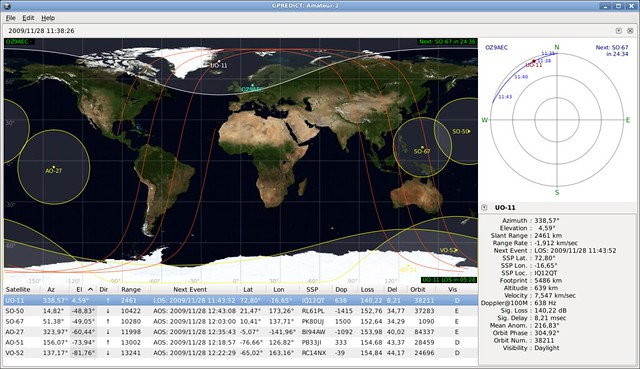
The other tricky aspect of making a satellite contact is that one must track the satellite as it passes overhead (azimuth and elevation). There is software available that will do this but one has to download the orbital parameters of the satellite from the North American Air Defense Command (NORAD). This combined organization of the United States and Canada tracks satellites orbiting the Earth and the parameters are known as Keplerian Elements. Amateur radio software will download these elements as an update - for example Ham Radio Deluxe and Gpredict and Orbitron. Alternatively one can track satellites manually at https://www.amsat.org/track/ .
Typically an amateur radio satellite operates with an uplink frequency and a downlink frequency. If the frequencies are on different bands we call this a cross-band repeater. During a pass of a satellite, these frequencies will appear to vary from the frame of reference of the Earth due to the Doppler effect. Astronomers might call this the red shift (going away - lower frequencies) and the blue shift (approaching - higher frequencies). In satellite phones or GPS devices, internal software compensates for this effect but in amateur radio operations the effect is very noticeable and can be handled manually or with software that automatically adjusts the radio's frequency. Other effects include changing polarization as the satellite tumbles relative to the ground station - so the antenna needs to be able to handle this (or the holder of the Arrow antenna can simply rotate the antenna too).
A satellite that receives a signal and then retransmits it, will do so towards the Earth. That portion of the satellite visible from the surface of the Earth (line of sight) is the satellite's footprint. Any amateur station within that footprint will receive the transmission from the satellite. This results in a huge area and the potential for long distance contacts with low power and a handheld radio. In the case of UO-11 in the image above, the footprint has a radius of 5,486 km. Of course the duration of the pass will be only a few minutes...
It is common for amateur radio contacts to be made from Earth via the International Space Station. There is a repeater on board and it is activated during Field Day. Sometimes the astronauts will speak directly to the Earth station. Sometimes contacts with schools are arranged - ARISS. There is also a packet repeater on board and APRS is a possibility as are signals sent by Slow Scan Television. See the video links below.
Sources:
- https://www.dxzone.com/catalog/Software/Satellite_tracking/
- https://amsat-uk.org/beginners/satellite-tracking/
- https://www.youtube.com/watch?v=MpZqaVwaIYk
- https://www.youtube.com/watch?v=h73EYcyszf8
- https://nwtresearch.com/
- https://nwtresearch.com/about/regional-research-centres/western-arctic-research-centre
- https://albertasat.ca/northern-spirit/
- https://www.ettus.com/product-categories/usrp-bus-series/
- https://www.asc-csa.gc.ca/eng/Default.asp
- https://www.asc-csa.gc.ca/eng/astronomy/northern-lights/default.asp
- https://en.wikipedia.org/wiki/Amateur_radio_satellite
- https://www.amsat.org/
- https://www.dummies.com/programming/ham-radio/how-to-operate-ham-radio-via-satellite/
- Details
- Hits: 3033
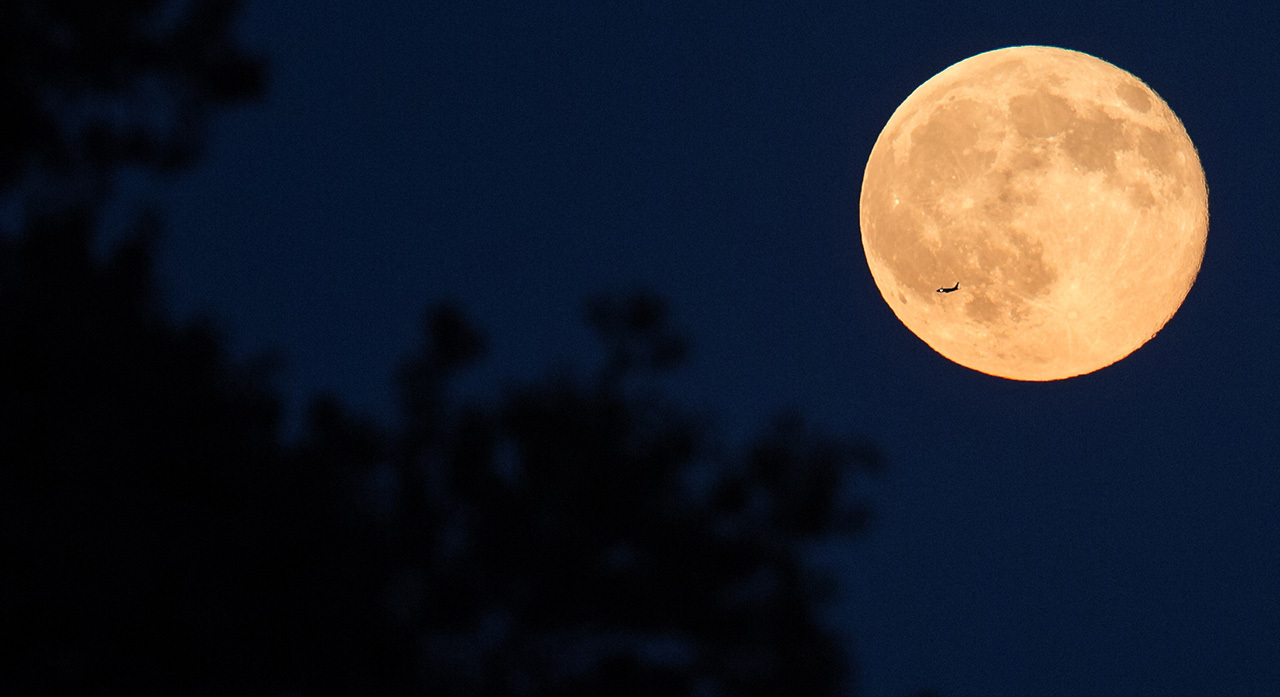
Earth-moon-earth (EME) or "moon bounce" is a radio-communications technique where a signal is transmitted from a ground station to the Moon and then reflected from the moon back to earth to another ground station within view of the Moon (i.e. within its footprint). In a sense this is the ultimate in satellite communications, where the Moon is the satellite. Unlike an artificial satellite however, there is no repeater receiving the signal and re-transmitting it.
EME communications were first proposed in 1940 and are believed to have occurred with RADAR experiments carried out in the United Kingdom and in Germany in 1943. RADAR is a type of radio transmission at microwave frequencies and it is used to detect objects in the air, at sea or on the ground. RADAR was developed by the Allies and the Axis Powers during World War 2. Accidental reflections were observed, from the rising Moon. Many a radio amateur was involved in RADAR's development. The first deliberate attempt at communication was carried out in 1946. A teletype link was established by the US Navy linking Pearl Harbour to Washington, DC - a useful link in the days before artificial satellites in 1957 (and the launch of Sputnik 1).

Most amateur radio EME communications are on the 2 m, 70 cm and 23 cm bands. Radio modes used include Morse code (CW) and digital modes (JT65).
There are multiple challenges to EME:
- Media interfaces - radio waves in EME must propagate through the Earth's atmosphere, which is of uneven density and which becomes rarefied with altitude. Parts of the atmosphere may also be ionized. Eventually the radio waves then must travel through the vacuum of space until they reach the Moon. The Moon has no atmosphere of significance. These differences in density cause attenuation and refraction (including reflection) of the radio waves. This means that the signal that reaches the Moon is weaker than from Earth. In addition the radio waves become less concentrated (diffused) and therefore even weaker.
- Irregular Surface of the Moon - the Moon has irregular surface features, such as mountains, valleys and craters. In addition the Moon is not flat but rather spherical-like. Signals aimed at the Moon are therefore reflected by these features and some signals end up being delayed as the travel to the lunar rim. Such delays result in different echoes. Echoes and polarization of antennas needs to be thought about. As the Moon is moving in relation to the ground station (and the ground station is also moving) thanks to rotation, these reflections vary and result in both constructive and destructive interference over time. This is called libration fading.
- Doppler Shift - as with satellites, the Moon is moving in relation to the ground station. This creates an effect knows as a Doppler Shift. At 2 m this shift can be a s high as 300 Hz at moonrise or moonset. Receiving and transmitting frequencies have to be adjusted to compensate.
- Faraday Rotation - this phenomenon affects polarization of signals. Most antennas have a preferred polarization but as the signals pass through the atmosphere, they may become rotated. This results in decreased antenna effectiveness if the polarization becomes mismatched. Since one is dealing with weak signals, that does not help matters. The effect is more pronounced at lower VHF frequencies, but less so at 1296 MHz and above. One way to mitigate this is to use antenna arrays.
YARS has a number of members who are interested in EME but to date no operational setup has been constructed or any experiment conducted. We probably have that capability as we can and do engage in amateur satellite communications.
- https://science.nasa.gov/
- https://www.electronics-notes.com/articles/ham_radio/amateur-propagation/moonbounce-propagation-eme.php
- https://rsgb.org/main/technical/space-satellites/moonbounce/
- Bouncing Signals Off Venus! (EVE?)
- Moon Phases | Current Moon Phase and Monthly Moon Phase Calendar
- Details
- Hits: 3395
When one thinks of astronomy one rarely thinks of amateur radio. Yet consider the electromagnetic spectrum - only a very small portion of that is visible light. Traditional optical telescopes only look at a small portion of the universe using visible light.
Accidental Discovery of the Black Hole at the Centre of the Milky Way

An electrical engineer named Karl Jansky carried some experiments into the propagation of shortwave radio signals in 1931 while working at Bell Labs. Through his observations of static he managed to detect a radio source that seemed to move depending on the day. Quickly he discovered that this radio source was extra-terrestrial and was in fact located in the constellation of Sagittarius in an area known as Sagittarius A - the supermassive black hole at the centre of our own galaxy, the Milky Way. Amateur radio was born by accident - a serendipitous discovery.
Yet black holes are not the only radio sources in the universe. In the 1950s radio telescopes resulted in the discovery of quasars. Closer to home the Sun was discovered to be an important radio source by accident during World War II when radar was being developed by the Allies. Observation of solar emissions can be used to predict solar activity - which results in solar storms and geomagnetic storms. Such storms can result in radio blackouts, aurora and confused migrating birds.

The planet Jupiter is a radio source and when Comet Shoemaker Levy was captured by its gravity and collided with the planet, this was observed via radio. Jupiter even has its own Jovian aurora, and that can be observed on the HF band here on Earth. NASA even has an educational outreach project on this subject, including a kit (Radio Jove). Amateur radio equipment is already capable of detecting these transmissions. The Jovian aurora interacts with aurora on some of Jupiter's moons.

Although not strictly astronomy, amateur radio satellite communications requires a basic understanding of tidal forces and the effects of solar particles on satellites. Since one has to track satellites, a certain understanding of Keplerian motion needs to be obtained. Early satellites such as Sputnik were first observed by amateur radio operators. Radio amateurs have observed variations of tone from satellite beacons to calculate information about the rate of tumble of satellites as they fall into the atmosphere and burn up. Some radio amateurs also try to intercept transmissions from deep space probes such as Pioneer and Voyager (source: http://en.wikipedia.org/wiki/Voyager_1; VE8EV's detection of NanoSail-D in 2010 at http://ve8ev.blogspot.ca/search/label/6m%2FEME%2FSatellite).
Radios can be used to observe astronomical effects - for example check out meteor scatter propagation mode on this site.
Aurora Borealis
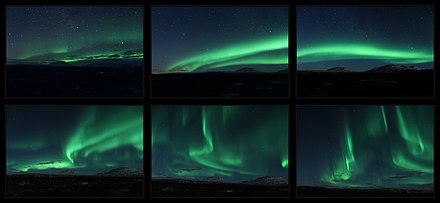
The aurora borealis (aurora australis in the southern hemisphere) is caused by the interaction of charged solar particles with the magnetic field of the Earth and the atoms of the gases in the Earth's upper atmosphere. The charged particles and field energize the atmospheric atoms of nitrogen and oxygen to make them glow. This is exactly how a neon lamp works. The aurora is the fourth state of matter - plasma.
For Yellowknife, the aurora is very important as there is a tourism industry based on it. Astronomy North and the Canadian Space Agency maintain observations of the aurora through a program called AuroraMax.
For amateur radio operators in the North, the aurora has a profound effect on radio propagation throughout the year. At times it may make propagation very difficult, it may make the effects of auroral "flutter" pronounced or it may make propagation very good. Quite often when there is a strong aurora over the south, we can make distant contacts under the auroral oval with European and Asiatic Russia, Scandinavia, Nunavut and the United Kingdom.
Earth (Planetary) Noises

Radio sources need not be extra-terrestrial. The aurora may have its origins from the sun but it is terrestrial for it is the interaction of solar particles with the planetary geomagnetic field. There are however other noise phenomenon that may be heard on radios - such as the Dawn Chorus. The spectrogram above shows a sampling of this. NASA has a recent satellite observation of this pheonomenon available at YouTube - Dawn Chorus. The radio emissions are generated in the Earth's radiation belts - the zone around the Earth that protects us from solar radiation. The aurora is probably related. While this is all very ephemeral, it has practical concerns for the safety of astronauts and satellites.
There are other planetary radio emissions - VLF noises. A collection of these in .wav format may be found at S.P. McGreevy's website. The manner in which these emissions arise is not entirely well understood.
Meteors
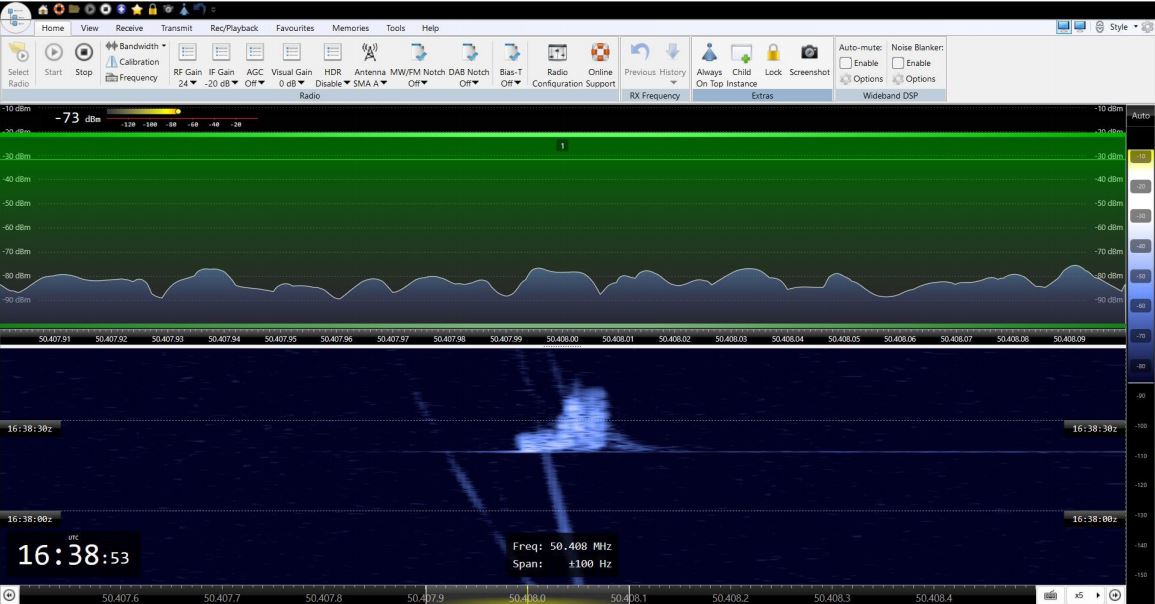
Here is an interesting video about Detecting Meteors with Software Defined Radio. There is an active project in the UK on this: https://ukmeteorbeacon.org/Home . There is a gallery on that website showing spectrographs of the meteor reflections of a 6 m beacon.
The equipment is very minimal - one needs just a software defined radio (SDR) and an antenna. SDR RTL receivers are very cheap and simply plug into one's USB port. While the UK beacon mentioned is probably a bit far for the NWT, other stations and beacons could be used. One could also go up to the FM broadcast bands to do this with FM stations.
The image above is from the website mentioned. The sloping trails are of relatively long duration (30 seconds according to the scale) and are aircraft reflections. From our work with amateur radio satellites they are probably a function of the velocity of the aircraft (remember velocity is a vector and includes speed and direction) - and what we see is a Doppler shift. The blue shift and red shifting are evident. The slope is probably an indication of speed. The direction from the receiver could be determined with a directional antenna. This is of course the principle behind radio detection and ranging - in effect: RADAR!
The meteor signals are of short duration (seconds) and are effectively the horizontal blur. This is because the meteor ionizes the atmosphere as it enters and burns up. See also our Meteor Scatter page.
Project Jove
Project Jove is a NASA-run project that is over 20 years old. It has evolved over the years. It is aimed at high school students in order to promote Science, Technology, Engineering and Mathematics (STEM). It is primarily aimed at observing the coupling of the auroral activity of Jupiter with some of its moons (Io and Europa). It can also be used to observe radio emissions of the Sun and galaxy. The project involves construction of a real radio telescope observatory, collecting the data and sharing it around the world. At one time a 10 m receiver had to be build but now a software defined radio (SDR) is now used. The antenna still needs to be built. A video of the project is at: https://youtu.be/L5KL0DZJOYw .
Conclusion
Amateur radio astronomy is an interesting bridge between amateur radio and the hobby of astronomy. Both are firmly rooted in the science of physics. Although one does not need a licence to observe, the technical basics of knowing how to use the tools of observation may be of great use in knowing how to observe and understanding what it is that one is observing. Astronomers after all should know about their telescopes, how they function and what their limitations are.
See:
- Details
- Hits: 2546
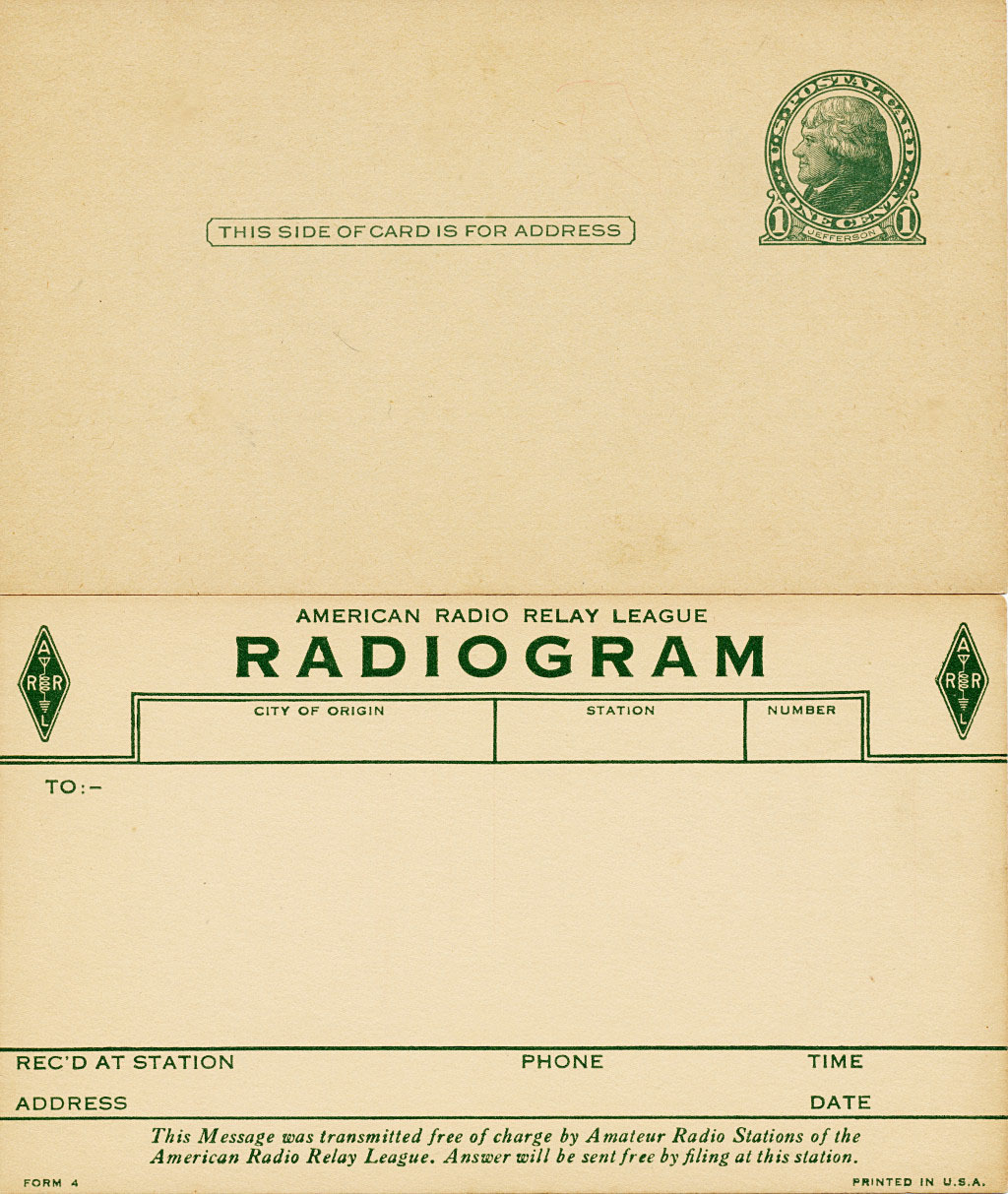
A radiogram is a formal written message transmitted by radio. Often referred to as a radio telegram, radio telegraphic message - or just a telegram (although a telegram could be sent by landlines such as a telegraph line), these messages follow a standardized format and are sent using standardized transmission procedures. Various header sections exist in the telegram so as to minimize time needed to transmit the message over congested channels and to ensure certain blocks of information are included. Historically these have been used by government, military and amateur radio organizations. Generally email messaging has superseded radiograms but it too adheres to a standard RFC-5322 etc. Commercial radiogram formats were established at the International Radiotelegraph Conference (Madrid, 1932). Maritime radio service telegrams formats are set out in Rec. ITU-R M.1171, § 28. NATO has a standardized radiogram format which is also used by the American MARS system (example) and the Canadian Forces Affiliate Radio System (of which the Yellowknife Amateur Radio is a member).
Radiograms provide a written record of radio communications and an audit trail. When used in emergency situations, they provide evidence of what was happening and when. Maritime distress messages are public records regardless of who transmitted them. They are logged and the log can also be used to reconstruct what happened or what is happening as an emergency progresses. Obviously the application to emergency radio communications has an analogue in applying to emergency amateur radio communications in support of emergency measures (or Civil Defence).
In some contests, the sending of a message can be used to accumulate points. While a contest may be a leisure event, there is no mistaking that in the amateur radio service all contests have a serious exercise aspect to them.
A typical Radio Amateurs of Canada Radiogram can be found at: https://www.rac.ca/wp-content/uploads/files/ares//Radiogram-VA3IDJ-colour.pdf . The instructions on the bottom of the radiogram are self explanatory. This radiogram format is the same as the ARRL radiogram: https://www.arrl.org/files/media/Group/Fillable%20Radiogram%20Form.pdf . The Incident Command System (ICS) radiogram format is ICS 213, an example of which is at https://training.fema.gov/emiweb/is/icsresource/assets/ics%20forms/ics%20form%20213,%20general%20message%20(v3).pdf with instructions.
The British Columbia Provincial Emergency Radio Communications Centre (BC PERCS) has quite a bit of useful information regarding message handling including the following:
The Forms on that site include a PERCS Radiogram but also other forms including a Radio Log, Outgoing Message Register, Quick Message Form and Initial Impact Assessment Form. In Civil Defence matters the amateur radiogram is not in isolation but rather part of the operation of an Emergency Communications Centre (ECC).
Additional sources:
- Details
- Hits: 2829
The Internet Radio Linking Project (IRLP) links amateur radio stations around the world through the Internet by making use of the Voice over the Internet Protocol (VoIP). This system is not unlike a VoIP based public land mobile network such as Skype or a VoIP based telephone system. Rather than having a computer-Internet-computer (as in Skype) or a telephone-Internet-telephone (as in a VoIP telephone system), IRLP has a HAM radio-Internet-HAM radio system. Internet access is typically another computer that takes the signal from the radio and turns it into a data stream that is then directed through the Internet to a designated IP address and station. The data stream is then converted back to a radio signal and transmitted on the radio at the other end. The central station with Internet access is called an IRLP Node. The local IRLP Node can be instructed where the data stream is to go by use of DTMF tones on the user's radio (typically a handheld VHF or UHF radio). Each node has a unique 4-digit node number assigned in the range of 1000-8999. As of 2019 there were 1,500 active nodes.
There are two types of nodes - node to node and a node to reflector. The IRLP node for VE8YK, run by the Yellowknife Amateur Radio Society, is numbered 1642. At the time of writing this article, it was not operational. VE8RT is currently working on upgrading the operating system so that the IRLP node may be run on Linux. For a note to function, the following equipment is needed (from Wikipedia):
- A dedicated IBM compatible computer, Pentium class (Intel, AMD etc.), running a processor clocked at least 200 MHz
- At least 128 MB of RAM
- A dedicated hard drive of at least 2 GB
- Basic (legacy) parallel port running LPT1 (0x378/9)
- Soundcard – most PCI cards work as do many motherboard based chipsets
- Ethernet Adapter (Network Card) connected to the Internet
The node to reflector is where a station speaks to 3 or more nodes at the same time. This is called an IRLP Reflector. It is not unlike a "party line" or a radio net. (This is why YARS's former general email distribution was called the "email reflector")
IRLP was invented in the late 1990s at the University of British Columbia. A directory of nodes is available at http://status.irlp.net/pdf/StatusByCTYPVCT.pdf .
IRLP is a good way to speak with amateurs around the world or down south. It is however reliant on public infrastructure (i.e. the Internet). Nevertheless for users with only the Basic Qualification, it allows them to speak with other amateurs around the world just on a low power VHF or UHF handheld radio. There are similar systems including Echolink. I recall having a QSO with a station in Bradford, England and the operator was so excited that he sent me a QSL card (which was quite an achievement for him as he was blind).
Links:
- http://www.irlp.net/
- http://irlp.net/pi/directions.txt {IRLP on a raspberry pi?}
- http://www.repeater-builder.com/irlp/irlp-index.html
- Echolink
- eQSO
- Details
- Hits: 3088

| Yellowknife Ski Club Current Weather Data |
THE YELLOWKNIFE SKI CLUB WEATHER STATION DATA IS NOT AVAILABLE DUE TO THE IGATE BEING TURNED OFF AND A NEW IGATE BEING CURRENTLY CONSTRUCTED AND CONFIGURED...
Remote or automatic weather stations (AWS) are an automated for of a traditional weather station. At traditional weather station has the following instruments, collecting data:
- Thermometer for measuring air and sea surface temperature
- Barometer for measuring atmospheric pressure
- Hygrometer for measuring humidity
- Anemometer for measuring wind speed
- Pyranometer for measuring solar radiation
- Rain gauge for measuring liquid precipitation over a set period of time.
- Wind sock for measuring general wind speed and wind direction
- Wind vane, also called a weather vane or a weathercock: it shows whence the wind is blowing.
More sophisticated weather stations have other devices to measure other weather parameters including UV index, soil moisture, cloud ceiling, visibility and so forth. Instruments are often placed in a sheltered box called a Stevenson screen. A personal weather station is a set of weather measuring instruments operated by an individual, club, association etc. Many such stations are available on the market. Often weather data is shared over the Internet via amateur radio.

The Yellowknife Amateur Radio Society is interested in personal weather stations that are automatic weather stations. Such stations include a data logger, rechargeable battery, telemetry, meteorological sensors and power generation (such as a solar panel or a wind turbine).
The APRS article on this website reveals at least three such weather stations as VE8WD-2 (Prelude Lake), CYZF (Yellowknife Airport) and VE8SKI (Yellowknife Ski Club). These stations send out APRS data streams to the IGate and they are recorded on the Internet and reported. The Ski Club project is intended to eventually provide real-time local weather conditions at the Ski Club for the skiers. Traditional weather reports, such as the one on this website in the right panel, originate from Environment Canada's weather station at the Yellowknife Airport. While the airport is close to the Ski Club, the weather information is not always identical. This is very evident in the summer as the Ski Club is closer to Great Slave Lake than is the airport. We regard these remote stations as an APRS problem and application.
Some of our members have been pondering the design of this weather station and are working on a potential variation of the project using raspberry pi computers to establish a network of weather monitoring stations around the Ski Club at check-in points. This is a potentially exciting project that will open up all sorts of hands-on experience with the collection of sensor data and its transmission to a central station (the Chalet) for use by skiers and for conveying to the Internet (so setting up the Ski Club perhaps as a mini-IGate).

All of this may seem a bit mundane, but we think once this project is done, we might be able to construct other remote sensory information collection devices - for example monitoring methane emissions (for climate change and permafrost melting), atmospheric sensors for a yet to be defined balloon mission, some sort of laser-based scintillation device to measure particulate density in the atmosphere, a device for measuring the planet's magnetic field, a seismometer and so forth. Once again, we can let our imagination run wild... These are not just though experiments but ways in which we can take command of the knowledge and expertise within the Society to learn from others and master the technology available to us.
Sources:
- https://projects.raspberrypi.org/en/projects/build-your-own-weather-station
- https://projects.raspberrypi.org/en/projects/build-your-own-weather-station/2
- https://www.instructables.com/Complete-DIY-Raspberry-Pi-Weather-Station-with-Sof/
- https://www.thegeekpub.com/260023/how-to-build-a-raspberry-pi-weather-station/
- https://www.youtube.com/watch?v=1LPEPZ02-t8
- https://www.youtube.com/watch?v=lPyDtuzYE5s
- https://www.youtube.com/watch?v=4SOjSBf-lmQ
- Details
- Hits: 3015

The Inner Whalebacks (Latitude 61º55'14'' and Longitude 113º43'46''W) is a set of islands located in Great Slave Lake, the 10th largest lake in the world and the 5th largest lake in North America (and larger than Lake Ontario or Lake Winnipeg or Lake Erie). On these islands a Daniels weather repeater system was installed around 2004 (images are at: http://www.ykars.com/gallery/index.php/2004-Images ) by the GNWT Department of Municipal and Community Affairs (MACA) and Environment Canada with assistance from the Yellowknife Amateur Radio Society (within the limits of their licences; some of the members involved were also qualified radio technicians and acting as such rather than as amateur radio operators).

The intent of the project is to beam maritime weather forecasts up the East Arm of Great Slave Lake. The East Arm is sparsely populated, although there is the community of Łutselkʼe with a population of about 330 in 2017. The area is very popular with recreational and Indigenous fishers (it is a known spot for northern pike and lake trout). This service is an example of the far reach of the Yellowknife Amateur Radio Society and its service beyond Yellowknife to local communities.

The Yellowknife Amateur Radio Society travels out to this location every year to inspect the repeater site and carry out basic maintenance and report on the state of the repeater. Members have gone out in the summer on boats or in the winter on snowmobiles. The Society's QSL Card is an image from 2004 of Chris Cameron at the site when it was being set up. The images on this page are from a 2009 inspection trip in the summer with the Coast Guard Auxiliary.

- Details
- Hits: 6490

Linux is a family of open source Unix-like operating systems. There are many versions of Linux with different user interfaces, themes and they are often tailored to specific interests including amateur radio, certain scientific fields and so forth. Linux can run an operating system on a personal computer or function as a server. Some distributions of Linux are designed for old obsolete computers, giving old computers a new lease on life. The operating system is usually free and one can even tinker with it as it is completely open to tinkering. The operating system comes with a library of software packages that are also open source and capable of being tinkered. Some of these, such as LibreOffice, are full-featured programs that are comparable in performance to commercial grade programs. For students, persons of limited economic means and not for profit organizations, this is very useful. Large organizations, including NASA and CERN are replacing their expensive operating systems with Linux. One has probably seen Linux already - Android is a version of Linux on smart phones and tablets. Linux has been notorious for its security - in a good way. Many of the security features now found in MS Windows were copied from early distributions of Linux. In 2015 it was estimated that 97% of web servers ran Linux. Linux is the preferred platform device for motion pictures.
For amateur radio operators, there is much software that runs on Linux for their applications. But amateur radio operators do like to recycle old equipment and Linux gives them the opportunity to put into use old computers. Recently small computers have come into being that are very cheap and very modifiable - such as the raspberry pi. These computers were intended for educational purposes as they were basic but gave access to the users to programming and various input and output ports (GPIO). They use very little power (5V and 3 A or 15W) and are very modular - one can install all sorts of hardware and program the computer to do a variety of tasks from running robots and drones, setting up weather stations, running a software defined radio or even controlling the watering of plants. There are variants that are even smaller and cheaper.
Some of our members are active in programming. Linux is quite easy to work with for the purposes of programming and was designed to facilitate computer science education. Programming can vary from C to Python.
Once again, this sort of tinkering is a way of exploring the technology at our fingertips and employing it for amateur radio and in our daily lives. Curiosity leads to learning which in turn, when combined with imagination, leads to interesting and novel applications.
Some Further Reading: