


Planning
- Details
- Hits: 2592
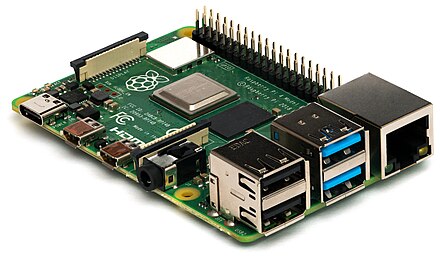
A Raspberry Pi is a series of single-board computers (SBCs). They were developed in the United Kingdom by the Raspberry Pi Foundation in association with Broadcom. These computers are small and relatively cheap. They are modular and the design is open. These computers were originally developed in order to promote computer science in schools. Computer and electronic hobbyists seized upon these computers. The first generation of Pi computers dates to 2012. Successive versions followed and the latest version is version 4. In addition a number of smaller, more basic version have been released including the Raspberry Pi Zero, and the Raspberry Pi Pico (which is more of a micro controller). These computers have an SD chip/card as a memory device and can operate most operating systems, although Linux is the favourite. They also have an Ethernet port, USB ports, a GPIO connector and in some cases HDMI port(s). The processor speed on the Pi 4 is about 1.5 GHz. The process or can be overclocked and this results in high chip temperatures, so one of the first modifications to do is to put on a heat sink.
There are modules (or HATS - Hardware Attached on Top) available that can be installed on the Pi including an HD camera, digital television, infrared cameras, touch screen displays and so on. One can design and make one's own customized HAT. There are even HATS that can be used as a software defined radio (SDR). A favourite set of HATS are weather sensors for a remote weather station. Robots and rovers can be made. High altitude balloon experiments also make use of sensors attached to a Pi.

There are other SBCs around, such as banana pi. There are also microcontroller kits for hobbyists such as the Arduino. There is an interesting trademark history about Arduino summarized in Wikipedia, but that is another story. Arduino has shields (which are like HATs) which can be used for many different purposes including 3D printing, satellite navigation, robots, servo motor control, Ethernet, LCDs, breadboarding etc. It has an IDE in Java. TenTec, a well-known amateur radio manufacturer, actually markets some amateur transceivers based on Arduinos: for instance the 507 Patriot SSB& CW QRP and 506 Rebel CW Tx/Rx .
The Yellowknife Amateur Radio Society is just starting to experiment with these. One of our initial projects will be to set up a remote weather station with a 2 m APRS link.
Sources:
- Details
- Hits: 2274
Software Defined Radio (SDR) is a radio that is implemented using software. It is a product of the convergence of radio communications with computing. Some SDRs are accessible online and one can actually listen to live HF radio via a web-based SDR.
- Details
- Hits: 3282

A telecommunications repeater is a device that receives a signal and retransmits it. Sometimes it is referred to as "remote re-broadcast" but in amateur radio we would not use that term as it is prohibited to "broadcast". Broadcast radio is commercial radio where programming including music is broadcast. That sort of transmission is forbidden in the amateur radio service. As shown in the diagram, the purpose of a repeater is to extend the range of one's radio by relaying the signal through a repeater that is more powerful, located higher up and thereby allowing greater coverage and even the overcoming of obstacles. A repeater need not be based on land - it could be on board a satellite orbiting the Earth. See the article on amateur radio satellites.
There are regulatory requirements in Canada relating to the operation of repeaters. The Yellowknife Amateur Radio Society operates repeaters but a licence holder still has to be responsible for the repeater operations. That licence holder must have the Advanced Amateur Qualification. For YARS that is Chris Cameron . Repeaters have their own technical challenges to confront but they are useful and can be linked to the IRLP system (the VE8YK repeater is so linked), to other repeaters (VE8YK and VE8RAE are linked) and even to the telephone system through what is called an auto or phone patch. In the days before the widespread use of mobile phones, amateur radio operators could initiate a phone patch from their automobiles.

The Yellowknife Amateur Radio Society runs two VHF repeaters in the Northwest Territories:
- VE8YK/R (146.940 MHz with -600 kHz offset with a 100 Hz sub-audible tone) based in Yellowknife; and
- VE8RAE/R (145.150 MHz with -600 kHz offset) based in Behchokho (formerly Rae).

Each repeater enables amateur radio duplex communications (or more properly half duplex communications or HDX). This enables an amateur with a low power handheld (which is cheap) to communicate via the repeater with stations that are out of range of the handheld radio but not the repeater.
Each repeater is located in these communities and has a power output of about 50 Watts. The repeaters have emergency power. The Society is greatly indebted to the Northwest Territories Power Corporation for providing space for the repeaters and room on their tower for our antennas.
The repeaters are linked at times and provide coverage from about Tibbet Lake to half way to Fort Providence and out to the Inner Whaleback Island group in Great Slave Lake. All licensed amateur radio operators are permitted to use these repeaters, including ones visiting. The repeaters are open for use.

The Society has an experimental repeater in operation using a YAESU Fusion Repeater. It is in analogue mode but we would like to experiment with its digital modes. It operates at receive 444.000 MHz and transmit at 449.000 MHz.
- https://www.repeaterbook.com/repeaters/Display_SS.php?state_id=ca01&band=14&loc=%&call=%&use=% [VE8PR, VE8EMG and VE8ECC are private repeaters and not affiliated with the Yellowknife Amateur Radio Society]
- http://www.bcfmca.bc.ca/repeater.php
- Details
- Hits: 3500
Introduction
Field craft is a term that we use to encompass useful skills that help to support our field operations in the winter and summer. The purpose of this page is to provide a handy reference to our members to assist them in field operations or in their own personal activities concerning amateur radio. This includes everything from camping to hunting and fishing and ropework.
Weather and Wildlife and COVID

Eight months of the year is winter in Yellowknife. There is snow, ice, wind and for much of that time long nights. Sometimes the temperatures drop below -40ºC (or -40ºF). The coldest day in 2021 was -45ºC (or -49ºC). With the wind chill, it can become dangerously cold where exposed skin freezes in seconds. If one spills kerosene, for example, on skin at that temperature, frostbite is immediate. With a breeze at 25 km/h and an air temperature of -35ºC, it feels like -51ºC and the risk of frostbite is 2 to 5 minutes.

Interesting things happen when it gets cold. LCD displays may freeze, expand and crack. Radios are normally not rated for operation below -10 degrees Celsius - so you might be operating outside of the specifications of your radio. Transmission line becomes really efficient but cables become really stiff. Antennas and metal can become quite hard to handle without gloves. Batteries freeze and their performance degrades. Antennas might accumulate frost and become heavy and unstable or even break. That said, these conditions make operating more challenging and the value of making a QSO from the North all the more impressive.
A car or skidoo breaking down in the countryside is not an inconvenience as it is in the South; it is a life-threatening situation. If an amateur radio operator is coming up here to operate, plan your trip and plan for contingencies. Bring proper clothing. Bring a heater, sleeping bag etc. Repeater coverage is not continuous along the highway and may be non-existent in the communities. The same goes for cell phone repeaters.

In the summer, while the temperatures are warmer, they are still generally cool by southern standards. Prepare for contingencies. Bring insect repellent and sunscreen. UV light is very strong at higher latitudes. Insects are very voracious here (although we do not have West Nile Virus, Zika etc.). Much of the Northwest Territories is full of wildlife and that wildlife can be dangerous. This is black bear and grizzly country. If you are near the Arctic coast, you might be exposed to the risk of polar bears. There are wolves, coyotes, wolverines, lynx, birds of prey (eagles), bison, moose etc. Of course with a hunting licence or fishing licence, one could eat well. There are also many edible plants and fungi (such as morels) but there are also some that are very toxic. Local indigenous populations possess a great deal of traditional knowledge and it can be useful. May such persons act as guides and one might consider using their services when "out on the land".
- https://spectacularnwt.com/
- Explorer's Guide to the Northwest Territories
- Information on Hunting Licences
- Northwest Territories Sport Fishing Regulations Guide
If you are coming from the south, you might want to verify what COVID-19 rules are in place. You may have to isolate or get tested. If you are coming from outside of Canada, remember that not only do the rules of the Northwest Territories apply but also those of the federal government of Canada. If you transit through another Canadian province or territory, the rules of that province or territory may also apply.
Knots
The tying of knots its a useful skill to have. While one need not know how to tie sophisticated knots, an ability to tie some the more basic knots is very useful. Whether it is securing a mast to the roof of a car or setting up a block and tackle to pull a heavy object aloft, knot tying comes in handy no matter what one is doing. We often use them for erecting antenna masts and the like. Working with wire ropes can also be beneficial.
Scouting knots is a useful website that gives some demonstrations as to how to tie some basic knots. The bowline, half hitch and sheet bend are highly recommended.
A very good resource for ropework and wire ropes can be found in BR 67 Admiralty Manual of Seamanship (May 1995). One can order any version of this volume online. While the ships might change, the use of ropes does not. This volume also has some instruction about ship handling and marine navigation.
Plants

It is possible to live off the land consuming plants. In the NWT some plants are very nutritious and others are poisonous. The GNWT Department of Environment and Natural Resources has published a guide booklet that may be of assistance.
- Details
- Hits: 3160
Amateur Radio Emergency Service (ARES)
Radio Amateurs of Canada has a fairly sophisticated Amateur Radio Emergency Service (ARES). This service is open to the participation of all amateurs. It is a nation-wide service and is routinely called upon by emergency measures organizations for the handling of communications - whether it be the transmission of public welfare messages or an augmentation to the emergency measures organization itself.
Although YARS is not actually part of ARES, it is affiliated with RAC and it has studied ARES. At some point in the future YARS hopes to become more involved with the ARES organization.
Northwest Territories Emergency Plan (2018)
YARS is a Non-Governmental Organization (NGO) and this therefore of a class of community resources mentioned at section 3.1.7 of the Northwest Territories Emergency Plan (2018):
3.1.7 Non-Government Organizations (NGOs) and the Private Sector
To ensure the most effective response to emergencies all available community resources need to be
considered as part of preparedness and response. There are a number of non-government volunteer
and private sector organizations located in many NWT communities. This includes church or faith-based
groups, service clubs, volunteer organizations, companies with work camps, equipment and supply
resources, and other agencies with resources and services that could be utilized during emergencies.
These organizations can provide a wide range of skills, manpower and equipment and may also have
extensive expertise and connections with vulnerable populations. Community and GNWT planners
should incorporate NGOs and private sector corporations’ capabilities and resources into established
emergency plans through established agreements.
Guidance for including NGOs and the private sector into community and GNWT emergency plans are
included at Appendix 3 – Planning Guidance – Non-Government Organizations and the Private Sector.
The top five hazards facing the Northwest Territories are (at article 3.2 of the Emergency Plan):
- wildfire;
- flood;
- severe weather;
- transportation incidents;
- critical infrastructure failure.
As YARS is oriented towards telecommunications, its role is evident (article 3.5):
3.5 Emergency Telecommunications
In an emergency, effective telecommunications is critical to establish situational awareness, ensure the
efficient exchange of information, coordinate response activities, exercise command and control, and
provide for responder safety.
The primary communications systems for management of territorial emergency response are telephone
voice and data using government systems. During major emergencies, departments or agencies with
operational mandates may have specialized systems that could be used to augment NWT EMO
operational communications requirements.
During communications outages, the NWT EMO maintains sufficient telecommunications equipment
and modes to communicate between the territorial EOC and regional EOCs and between regional EOCs
and communities. Departments and agencies are required to ensure sufficient back-up communications
capability to communicate with the territorial EOC, regional EOCs and internally to support response
activities during emergencies.
City of Yellowknife Emergency Plan (2019)
The City of Yellowknife has prepared an Emergency Plan in the form of the Emergency Measures Bylaw No. 4996. That Bylaw is not terribly informative but the Memorandum to the Committee of April 23, 2019 is at page 72. More significant is the City of Yellowknife Emergency Management Plan (starting at page 80). Chapters 8 (Emergency Response) and 9 (Standard Operating Procedures) are of significant to YARS. YARS has a role as an outside agency (s. 6.4) in the Emergency Operations Centre (EOC) and also at section 7.3.2 as an "other agency". Much of the Plan is coordinated with the Emergency Management Act, SNWT 2018,c.17.
At section 8.4 of the Plan, the following locations are designated:
- Primary Emergency Operations Centre (EOC) - City Hall 4807 - 52nd Street. The Corporate Boardroom is the Emergency Operations Centre.
- Alternate Emergency Operations Centre - 2nd floor boardroom of the Fire Hall, Station #1, 100 Taylor Road.
- Primary Emergency Shelter or Reception Centre - Fieldhouse or Multiplex (one or both).
- Secondary Reception Centre for emergencies - École Saint Patrick School facility.
Located in École Saint Patrick is the Physics classroom and located in that is the old computer lab. It is here that VE8PAT is located, YARS' main operating station. This station and facility has emergency generators, VHF and HF capability and is used, tested and maintained regularly. There are antennas on the roof of the building.
YARS Can Provide Assistance and Support to Civil Authorities During Emergencies

There are various reasons why the amateur radio service is attractive to emergency preparedness organizations:
- More frequencies. The amateur radio service has substantially more frequencies on which to operate. In fact while emergency services might have specific frequencies allocated to them, the amateur radio service has bands - tens of thousands of frequencies allocated - and these frequencies and bands are more useable at different times of the day or year.
- Infrastructure independent. Radio amateurs' equipment is generally infrastructure independent. We have our own power sources, solar panels, antennas etc. If the phone lines or power lines are down (or the Internet), we are still capable of communicating with the world. Since the equipment is our own, we are already trained on it and have experience using it.
- Diversity. Because our stations are spread out all over the place and not concentrated in one location, should an event occur that renders that one location no longer viable, it does not matter to us.
- Training. Radio amateurs are trained and experienced. They have technical skills and savoir-faire in the operation of radio systems, building of antennas, circuit design and so forth. This is proven as a licensed amateur radio operator has to have passed standardized examinations by Industry Canada to obtain their licence.
- Volunteers. Radio amateurs are volunteers. They are motivated. They do this sort of activity because they want to do it. "HAM" radio is non-commercial. Radio amateurs have invested in their own training and equipment, at their own cost and without expectation of reward - a form of community service.
Everything that we do is oriented to that one day when we are asked to provide assistance. Whether that call is from a powerboat or from an emergency measures organization, we strive to be ready. Readiness is achieved and maintained through fox hunts and ARDF, contesting, learning how to solder, learning about low power (QRP) operations or simply maintaining logs for QSL cards. We remain flexible.
Local and Territorial Emergencies and YARS Volunteers
In theory we could serve either the local community (Yellowknife and area) in a local emergency or the Northwest Territories (through the Department of Municipal and Community Affairs) in a territorial emergency. We could either serve as formation in our own right or attach individual members to the civil authorities to assist. Our ability to meet such a challenge would depend on the circumstances at the time and the availability of our members.
Naturally provisions of the Emergency Management Act, SNWT 2018,c.17 and in particular provisions about volunteers including provisions regarding compensation (section 23) and liability (section 24). Section 4 of the Workers Compensation Act, SNWT 2007,c.21 would also apply to volunteers. YARS had quite a bit of say in the development of these provisions when they were developed.
HF Emergency Frequencies
| Single Sideband | CW | Digital | ||||
|---|---|---|---|---|---|---|
| Band | Frequency | Tactical | Frequency | Tactical | Frequency | Tactical |
| 80 M | 3.675 MHz LSB | Alfa | 3.535 MHz | Golf | 3.596 MHz | Mike |
| 40 M | 7.135 MHz LSB | Bravo | 7.035 MHz | Hotel | 7.096 MHz | November |
| 20 M | 14.135 MHz USB | Charlie | 14.035 MHz | India | 14.096 MHz | Oscar |
| 17 M | 18.135 MHz USB | Delta | 18.075 MHz | Juliet | 18.096 MHz | Papa |
| 15 M | 21.235 MHz USB | Echo | 21.035 MHz | Kilo | 21.096 MHz | Quebec |
| 10 M | 28.235 MHz USB | Foxtrot | 28.035 MHz | Lima | 28.096 MHz | Romeo |
https://www.rac.ca/national-hf-emergency-communications-frequencies/
- Details
- Hits: 2425

YARS provides radio coverage of some community events from time to time. The events must be non-commercial. Typically YARS uses these events to test out its ability to establish a wide area radio net in a field environment under different climatic conditions.
The annual NorthwesTel Ski Loppet is our primary winter exercise. It complements our primary annual exercise, which is Field Day in June. The organizers of the Ski Loppet, the Yellowknife Ski Club, benefit from our work as they have emergency radio coverage that may be relied upon to coordinate a response to an emergency (such as a skier being injured).
This type of service is quite common amongst amateur radio societies. YARS provided radio coverage for the Frostbite 45 challenge run by the Yellowknife Multisport Club. Other clubs in Canada do coverage of marathons, fireworks displays etc.


- Details
- Hits: 2675

What is ARDF?

Amateur Radio Direction-finding (ARDF) is a type of radio sport. It is sometimes referred to as transmitter hunting. Like all radio sports, ARDF has a very important role in building skill sets. In this case being able to correctly trace and find the source of a radio signal has its applications in locating of emergency transponder beacons, persons lost but who have a radio and interfering transmissions. Not surprisingly this sport has its origins in the former Eastern Block of nations and was promoted by those governments because of its potential military and security applications.
ARDF is a formal competitive sport that combines radio direction finding with orienteering.
Generally YARS engages in a less formal activity called a "fox hunt", however we are gradually moving more and more to ARDF as we become more familiar with the activity.
The Challenge
A key challenge in ARDF or fox hunts is discerning between signals that are reflections and signals that come directly from a transmitter. If the signal is direct, we can simply shoot up a bearing and obtain a line of bearing to the transmitter. Several lines of bearing can be used to pinpoint the transmitter using applied geometry - triangulation. If the signal is a reflection, it can throw one off as false lines of bearings are plotted to the object(s) that reflect the radio waves.
To discriminate between direct and reflected signals is a bit of an art and requires some thinking about the topography of the land and the objects on it (and sometimes in the air).
There are many applications of this sport to search and rescue and the pinpointing of interfering signals.
Physical
ARDF, as a sport, attempts to fuse radio direction finding with orienteering. It is probably one of the more physically intensive aspects of our hobby (next to erecting antenna masts and hiking around for remote operation). YARS has not gone to orienteering yet and tends to do hiking instead. In the winter we might do snowshoeing.
Competitive
There are international competitions and since YARS is located in North America, the ARDF rules of the International Amateur Radio Union apply (Region 2). Generally YARS is working towards following these rules as it gains more skill and insight into how to conduct these events.
Equipment

Equipment is fairly modest:
- One needs some fox transmitters. This could be a person with a transceiver transmitting or it could be remote low powered transmitters that cycle on and off periodically.
- If orienteering is used, one will need orienteering equipment.
- A map of the area and compass might be useful for the taking and plotting of bearings.
- One should use use a time difference of arrival device or a directional antenna, attenuator, receiver and so forth. A number of YARS members have built their own time difference of arrival devices from scratch or from kits (yes this is an amateur radio club - we do build this sometimes!).
Further Reading
- Edmonton Area Fox Hunting League
- A Beginners Guide to Amateur Radio Foxhunting
- A Transmitter for Fox Hunting
- Details
- Hits: 6767
Shortwave-listening is an inexpensive way of learning about radio propagation without the need for a licence or elaborate antenna set up. One can listen to amateur radio operators, weather stations, broadcast stations and even diplomatic and military traffic. Some stations even provide language lessons. New dimensions are opened up with these stations being present on the Internet. Has anyone looked at the recipes for Japanese food on NHK or Haggis on the BBC?
Shortwave listening is a terrific way to start learning about radio and electronics as well as news and culture from other countries. It is a window on the world. Today one does not even need a radio as there are many options thanks to the Internet.
The Software Defined Radio (Free Real Time Radio Monitoring)
It is possible for one to monitor HF frequencies via the computer thanks to various software defined radios that have been hooked up around the world. It is possible to even use some of the digital monitoring software to decode signals using these radios. Sometimes we even use them to see how our own signals from Yellowknife are being heard in Edmonton, Calgary or abroad. For more on software defined radios, click HERE.
Traditional Shortwave on High Frequency Bands

One need not be licensed to listen to the shortwave radio bands - however if one is going to transmit, generally one needs a licence. Yet much of the time spent by licensed amateur radio operators is spent observing and listening. Simply listening reveals a great deal about propagation of radio waves through the atmosphere. One of the most fundamental processes in any scientific inquiry is to observe.
A shortwave listener can listen to programming from various parts of the world in various languages. Listening to foreign languages is one way of learning those languages. One can also learn about foreign cultures and about current events in far off lands. One could even use some of the data techniques of amateur radio to intercept HF weather reports, fax transmissions, radio teletype (i.e. news-wires) and so forth. One can also listen to foreign news broadcasts.
International shortwave broadcasting has an interesting history. Shortwave broadcasts have been part of the HF bands since the 1920s and will probably continue to be present, despite recent cuts to a number of services (domestic and foreign).
In today's age of the Internet, we often take for granted instantaneous news. But there are times when the Internet fails, is shut off, is censored or when the infrastructure required to power it fails (solar storms, fallen lines, destroyed power plants etc.). With the onset of war in the Ukraine, many governments are realizing that the discontinuation of shortwave services and the dismantling of their infrastructure in favour of the Internet was short-sighted. The BBC for example has restarted its shortwave services.
The equipment required for shortwave listening is relative minimal and very cheap. Shortwave receivers can be found for under $15 although a half decent receiver will run $100 and up.
Frequencies
For those of you who have a shortwave receiver, here are the broadcast bands on which international shortwave services transmit. Unfortunately the services offered by Radio Canada International and Radio Netherlands have been curtailed greatly as they rely more on internet, satellite and local feed broadcasts over shortwave.
If you are after a programming schedule with times and specific frequencies of certain services, you should go to the website of those services and download a frequency schedule. Scheduling changes according to season and time of day to make efficient use of atmospheric propagation.
|
Band |
Frequency Range |
|
120 m |
2300 – 2495 kHz |
|
90 m |
3200 – 3400 kHz |
|
75 m |
3900 – 4000 kHz |
|
60 m |
4750 – 5060 kHz |
|
49 m |
5900 – 6200 kHz |
|
41 m |
7200 – 7600 kHz |
|
31 m |
9400 – 9900 kHz |
|
25 m |
11,600 - 12,200 kHz |
|
22 m |
13,570 - 13,870 kHz |
|
19 m |
15,100 - 15,800 kHz |
|
16 m |
17,480 - 17,900 kHz |
|
15 m |
18,900 - 19,020 kHz |
|
13 m |
21,450 - 21,850 kHz |
|
11 m |
25,600 - 26,100 kHz |
While shortwave broadcast radio is not really in the realm of amateur radio, the physics behind radio propagation still apply. For many an amateur radio operator, shortwave listening is a door into the hobby, sparking interest in radios, propagation and current events. For many in other countries it was through this medium that they learned a foreign language (e.g. English). And the programming is usually better than TV. For many an amateur radio operator, the hobby is a gateway into further inquiry and experimentation often leading to a career in technology and science.
Monitoring
 Amateur radio transmissions can be monitored by anyone with a receiver. Some listeners use more sophisticated means such as hooking up their radio with a computer and monitoring digital traffic. They can and do often send reception reports such as the QSL card above. Broadcast stations do this too as do most other stations (such as weather fax and airport beacons), These reports are useful as they give the transmitting station an idea of propagation.
Shortwave on the Internet
Through shortwave radio, the world is available even in remote locations with the flip of a switch. No computer is needed. No internet connection is needed. With batteries, one does not even need access to the power grid. Signals bounce around the Earth and reach your shortwave receiver.
Convergence of shortwave radio and computing has occurred. One can easily visit a website and listen to programming, download schedules and frequencies and read interesting articles. The signals heard are devoid of atmospheric distortion and in high quality audio. Sometimes there is even TV. But one is dependent on the infrastructure that underlies the Internet.
In our experiments with Linux we have come across a Linux-based application called "Shortwave". The application is based on the RadioBrowser web-based collection of internet radio and TV stations. That website is run from Germany and is open source. It contains about 56,948 stations as of 2026-05-24 in 630 languages and from 238 countries.
While this approach is interesting, it is dependent on the Internet and its infrastructure - fibre optic cable, regular mains electricity, satellites etc. The quality of the broadcast signal is great (full FM) but it goes against some of the traditions of the amateur radio service - including an ability not to be dependent on the existing infrastructure. Remember infrastructure can be destroyed and the Internet and satellites turned-off. At one time it was inconceivable for the Internet to be destroyed or turned-off - it being set up specifically to withstand a nuclear strike during the Cold War. But we have seen the Internet turned-off and censored in recent years - so much so that broadcast shortwave services have been reactivated.
Sources:
- https://csdl-downloads.ieeecomputer.org/mags/it/2020/06/09250315.pdf?Expires=1779654664&Policy=eyJTdGF0ZW1lbnQiOlt7IlJlc291cmNlIjoiaHR0cHM6Ly9jc2RsLWRvd25sb2Fkcy5pZWVlY29tcHV0ZXIub3JnL21hZ3MvaXQvMjAyMC8wNi8wOTI1MDMxNS5wZGYiLCJDb25kaXRpb24iOnsiRGF0ZUxlc3NUaGFuIjp7IkFXUzpFcG9jaFRpbWUiOjE3Nzk2NTQ2NjR9fX1dfQ__&Signature=OG~4kGApEfFuy6DiWovV1iHJSXYHG7xRkhQqP-2mFo9rAliyWWW6QTDDYJiNT13AOXBWCaQKFM6Ns-Hw~u3Uw-2UIusMTbPhyDYWBbkIAf8T5t8npb8PQ70ClWGkcJZ54Vgng9pL-ikjUTWwbtYskLpe8VvP4WHBQSL1FwS5HS9QeA0sse8wUK3Ccb7CR~-TV1hE5h4Aot8ZkCVYAEzAXJW9dJDFGBwaiIoPBWvOHBd-0Mpw74UhB2ikGZkXRF0Bcn9nVFRtMvY4dGoK1Wu0XcmNP3g3wGueudaJoc1T9b6Tu5WWUMQ2nEgfclI0DzOj~pAx4XI9xiGV81MJQ2hC5Q__&Key-Pair-Id=K12PMWTCQBDMDT
- https://www.reddit.com/r/shortwave/comments/t7sgy7/is_the_current_world_situation_a_perfect_storm/
- https://www.radioworld.com/columns-and-views/guest-commentaries/why-reviving-shortwave-is-a-non-starter
- Details
- Hits: 4389

Morse Code (CW) is an operating mode (often referred to a "continuous wave" or CW) for the amateur radio service (also known as A1A radio emissions using the ITU type classification). A continuous wave (CW) of constant amplitude and frequency is turned on an off. Duration of the wave is used to denote a dash (-) or a dot (.). Combinations of dashes, dots and periods of no wave can be assembled to represent a character. Combinations of characters make up words. And words make up messages.
This is called telegraphy. The image above is of such a system known as an optical telegraph. It was used in Napoleonic times for visual communications. The modern day successors to this system include railway signaling systems, traffic lights etc.
In wireless communications systems this is called radiotelegraphy. Pioneered by many famous engineers and inventors, it was really Guglielmo Marconi who brought about the use of radiotelegraphy as a commercially viable activity. More importantly his work, and that of others, transformed the 20th Century. Perhaps an even more significant evolution of radiotelegraphy was the quest for the harmonic telegraph - an attempt to use different tones and thus send multiple CW messages using the same wire. This eventually led to the invention of the telephone by Alexander Graham Bell as well as Frequency Division Multiple Access (FDMA) - something in common use today with wireless networks and cellular telephones. A simple 19th century technology at the root of modern day technologies...
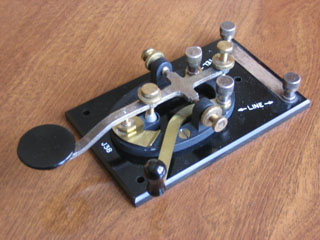
For the amateur radio service, the image of the amateur radio operator (HAM) tapping away at a straight key is a stereotype. And while Morse Code seems archaic, there is a reason why it remains in use.
Technologically one does not need much equipment to send out CW or to receive it. The equipment is not sophisticated and can easily be built and maintained. Power requirements are fairly low and bandwidth is narrow. Because CW is modulated onto one tone, that tone can easily be picked out of the noise floor by the human ear. While there are computer programs that can decipher CW, having a sophisticated computer defeats the elegance of the simplicity of CW (it is "cheating").

In the North, all of this makes CW a very relevant mode. It is conducive to low power operations (QRP) and one can simply toss a CW transceiver, key and battery into one's backpack and set up an operational CW stations in the middle of nowhere. With solar panels to recharge batteries, one has an amateur radio station deployed and capable of being operated indefinitely.
YARS is very interested in promoting CW. For those of its members who have the Basic Qualification without an Honours Pass, getting a CW 5 WPM Qualification opens up the HF bands to them. For Field Day, each CW contact is worth 2 points, while each voice contact is only 1 point. There is a reason behind this difference in score value - and it has to do with emergency preparedness as well as well as skill.
More importantly, as revealed in contests, CW operators tend to invest in antennas and carefully listen for CW contacts. We have found that if we can hear them, they can hear us. This is not the case in SSB communications where many amateurs prefer blasting high power but their antenna set-up is poor as is their equipment and they are unable to hear the weaker stations. Many a time we have replied to an SSB station only to receive silence from them. This has never been the case with CW.

During contests we often operate in CW. We usually get extra points. It is possible to send and decode CW signals using a program such as fldigi, but it is more challenging to do that manually and by ear.
- Details
- Hits: 8276
A Do-it-Yourself (DIY) Website
2026-05-08 - We have updated the website to v. 5.4.5. Some of the bugs have been resolved and this is reflected by their correction on the website. Masthead has been fixed and so has the RRS feed for the weather in Yellowknife. A number of images were broken - these came from Wikipedia. They appear to change from time to time. Civil Defence page is being updated.
2022-09-07 - Strangely this article is the most read article on the website. We think there is great interest in DIY websites.
Around 2012 the Yellowknife Amateur Radio Society (YARS) decided to take control of its domain name and to build its own website, rather than contracting that out. This was a cost-saving measure but also a way in which to abandon the use of the increasingly defunct FrontPage software used to maintain HTML pages on the site. One can see the original site by looking up YKARS.COM in the Wayback Machine.
In 2012 we decided to make use of Joomla 1.3, an open source content management (CMS) program. The use of a CMS is how most modern websites operate and others in use include WordPress and Drupal. In 2012 Joomla was one of the most popular. In 2020 WordPress (which is actually a blog system rather than a proper CMS) was used by about 40.4% of websites on the Internet, followed by Shopify and then Joomla. On 17 August 2021, Joomla released Joomla 4.0. We decided to abandon Joomla 1.3 and work with Joomla 4.0.
On 23 August 2021 we deactivated the old site and embarked on creating a new site under Joomla 4.0 and its upgrades. All links on the website are gradually being verified and articles put through an editorial review. We will also be installing and using a mass mailing system that conforms to Canada's anti-SPAM legislation. Persons may subscribe. Also we will be setting up a blog type newsletter to replace our old newsletter, The Ensign. That newsletter was discontinued and taken off-line around 2015 for various reasons, despite its popularity.
Category Organization Follows Incident Command System (ICS)
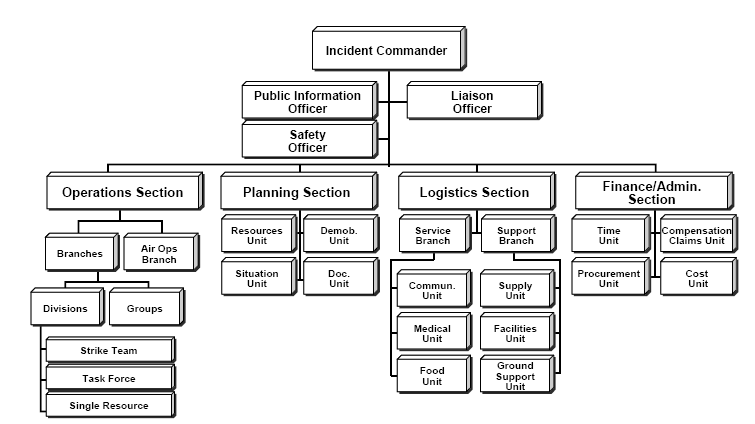
This website is structured using the Incident Command System (ICS). That system is a standardized approach to the command, control and coordination of emergency response, providing a common hierarchy that can be used amongst multiple emergency response agencies. It is scalable up or down and so can be used in a relatively small organization such as YARS or a huge organization such as the armed forces. Those in the armed forces might see a similarity to the General Staff System (GSS), based on the 19th century French army system.
The ICS and its adoption by YARS is a key component to our orientation to emergency preparedness and our function in emergency management or civil defence.
The ICS is also an important management tool mentioned in the Northwest Territories Emergency Plan (2018):
6.2 Incident Command System
The Incident Command System (ICS) is an incident management tool designed as a standardized and
coordinated approach to managing emergencies that provides functional interoperability at all levels of
emergency management. ICS breaks up tasks into functional areas of Command, Operations, Planning,
logistics and Finance/Administration. The NWT EMO has adopted ICS as its response model for the
purposes of the NWT Emergency Plan.
Articles
We have systematically reviewed all articles, adding new articles and corrected most broken links. If you think that an article should appear or have comments, let Ian Rennie know. Registered users have the ability to login to our system and submit articles. They will be put through an editorial process before they are published.
Captcha
 We started to receive some robot emails that were testing the contact page in preparation for the sending of spam emails for the soliciting of Viagra and mail order wives etc. This is very common. To counter this we installed a Captcha ("Completely Automated Public Turing test to tell Computers and Humans Apart") system so that robots that attempt to do this sort of thing are defeated. Usually a user has to enter in characters that appear in some sort of image or count the instances of an item in a picture - in this case we were able to install such a system that is invisible to the user. We are touching upon the realm of hackers and artificial intelligence with CAPTCHA. Unfortunately this a reality of the Internet.
Updates
2022-09-07 - Today we updated the CMS to Joomla 4.2.2. We will probably implement 2-factor authentication in the near future to make the site more secure.
Joomla 4.0 has gone through 4 updates since its release. Joomla is a content management system (CMS) - the modern approach to running a website. Essentially a CMS is a database and the maintainer, through a backend, carries out data entry - so an article is a form of data. When a visitor visits the website and a link, they launch a query that reports on the data and dynamically formats it into whatever pre-defined format has been set up. Maintainers do not need to worry about any formatting and are effectively just data entry operators. Joomla 4.0 has gone through many updates since its release in August 2021 and we are now running Joomla 4.1.3 as of 11 May 2022.
As of April 2023 we are running Joomla 4.3 but we have also realized that with the upgrading our photo gallery has failed to function properly, so we have de-activated it. The website images generally link directly to our image files - unless they are in the public domain, in which case we just link them (saves space).
As of 2023-05-02 we are now operating Joomla 4.3.1. We also updated the footer copyright year.
As of 2023-05-09 we have solved the photogallery issue and have full capabilities. We have ditched the old web gallery system and installed the RC Gallery plugin. An Example of this is the restoration of the QSL gallery at http://www.ykars.com/index.php/amateur-radio/activities/qsl-card-gallery . We did the same thing with the abandonment of Luxcal and installed JEvents extension for the events calendar: http://www.ykars.com/index.php/events . In addition we have figured out how to make banners work properly as shown by the banner for this week for Emergency Preparedness week.
As of 2023-05-30 we are running Joomla 4.3.2.
As of 2023-07-12 we are running Joomla 4.3.3.
As of 2023-11-29 we are running Joomla 4.4.1.
As of 2024-12-18 we updated our PHP file from 5.6 to 8.2. Joomla was giving us a security warning. This has now been fixed. While we are running Joomla 4.4.6 at this time, we are looking into upgrading to Joomla 5.x.
Users and Mass Mailings
9 May 2022. We have set up the user features and users may login to access restricted articles and submit their own articles for addition to the website. These articles will go through an editorial review - to ensure there are no copyright violations or to check spelling and grammar etc. We have the capacity to accept articles in French as well as in English. The users are also subject to mass email-ings - and we make sure they are bcc'd and that there is a footer explaining how they got on our email list and how they can get off it - in compliance with Canada's anti-SPAM legislation.
Accessibility Checking
Interestingly the current version of our CMS has an Accessibility Checking feature. Many of the images (i.e. all of them on this page) fail that check but the text is alright. We think this is for visual accessibility by the visually impaired.
Images Issue
2025-02-02 - The Masthead to the website has been altered by adding the Canadian national flag, the Royal Union Flag (with its placement it is symbolic of the Crown) and an improved version of the flag of the Northwest Territories. The placement of these flags is to show solidarity with 41 million other Canadians and the citizens of other nations being targetted - including Americans.
2023-07-02 - The image problem has now been fixed. Initially we attempted to make use of an independent gallery program CMS and that was quickly found to be incompatible with the underlying system. This is why our photo gallery disappeared for a while. Eventually we used a simple gallery plugin for Joomla, the overall CMS and generated a library of images over the years. This also allowed us to start cleaning up our underlying subdirectories to free up space. In the process a number of image links were broken. Over the next little while we will correct these image links, so please bear with us.
More Testing
2023-07-12 - Testing way in which menus and listings of articles work - See Activities and the Linux sub category. The plan is to modify the listings under Activities so as to maintain a document repository.
Some Bandwidth Errors
2024-07-16 - We were getting notifications of bandwidth issues. Our thinking is that the images we had online were occupying too much space and being visited too frequently by robots. We have deactivated the photo gallery and also the activities pages.
2024-12-18 - A cursory examination of the website statistics reveals that there are a fair number of robots spidering our site. We have not blocked this and note that some AI systems have scanned our site and summarize aspects of it.