


Planning
- Details
- Hits: 3425
What is the Aurora?
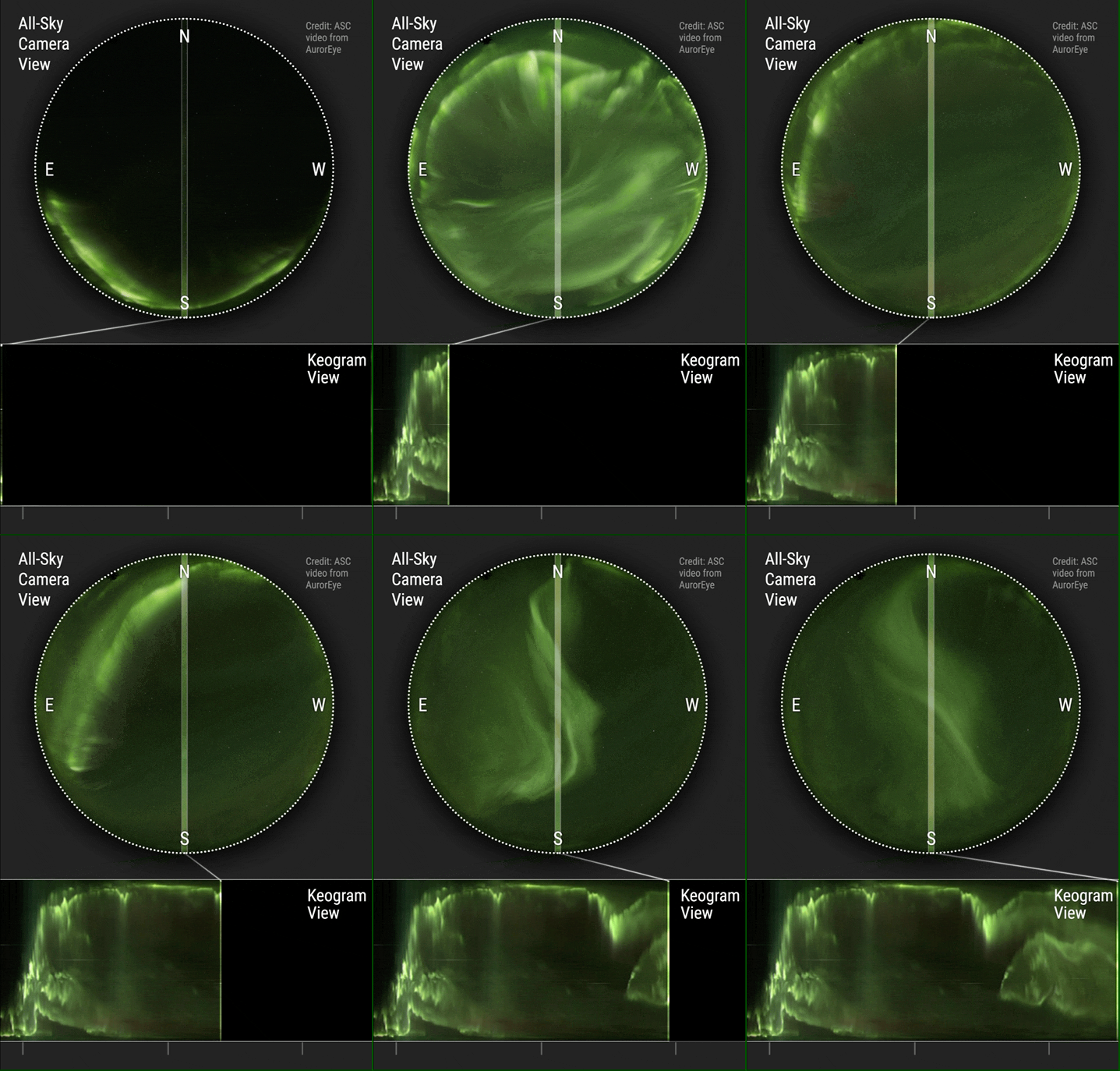
The aurora borealis or Northern Lights is an atmospheric phenomenon that occurs in the northern hemisphere of the planet. It also occurs in the southern hemisphere where it is known as the aurora australis. Aurora are known to exist on comets, brown dwarfs, other planets and on some moons. Aurora are caused by solar wind interacting with magnetic fields and atmospheric particles. Atmospheric particles become energized and form what is known as plasma. Plasma is energized or ionized gas. It is the fourth state of matter and has been so identified since about 1972. Yes, your high school teachers who taught you the three states of matter were...well...not current in their physics. You see plasma every day when you see the sun, an operating fluorescent light or an operating neon light.
- Details
- Hits: 5256
The Wagon-wheel Effect, Stroboscopic Effects and Aliasing
Sometimes in movies one sees a stagecoach rambling through the countryside with some notorious highwayman (such as Dick Turpin) in hot pursuit. The wheels appear to be going in the opposite direction at a very slow speed or not turning at all. Images of any rotating object, including helicopter rotors or aircraft propellers, show this. This phenomenon was mentioned one morning by YARS members during coffee and I decided to write an article about it. One of our members mentioned a "stroboscopic effect" where, with a strobe light flashes at a sampling rate close to the period of motion causes this effect. For example if a light flashes at 60 flashes per second (60 Hz) and the rotating object is rotating 60 revolutions per second (60 Hz), then the object will appear to be stationary. If the object rotates at 61 revolutions per second, it will appear to slowly appear to move backwards. At 50 revolutions per second it will appear to rotate slowly forwards.
This effect can be used to measure the speed of moving objects simply by observing them. It can also lead to irritation by persons sensitive to the effects, sometimes called "flicker". This has nothing to do with a phenomenon called "rolling shutter" - which is merely a time delay artefact in a digital camera caused by how the camera scans an object over time, line by line (see https://www.youtube.com/watch?v=dNVtMmLlnoE ).

Read more: The Wagon-wheel Effect (Nyquist Frequency and Aliasing)
- Details
- Hits: 151
G4FON Ray Burlingame-Goff became a silent key (SK) on July 29, 2021. His website still remains in operation at: https://www.g4fon.net/ . When it goes silent, it can probably still be accesses through the Internet Archive. His site contains a free Koch CW Trainer. We recommend that for training. There are also options for running simulated CW pile-ups with noise (QRM).
- Details
- Hits: 7477
The Morse Code examination is governed by section 6 of RIC-1 - Guide for Examiners Accredited to Conduct Examinations for Amateur Radio Operator Certificates.
The examination is at 5 words per minute, which is very slow. There is a sending component and a receiving component. Sending and receiving must be done by hand and by ear only. The actual characters are sent at 12 words per minute, but the spacings between characters are at 5 words per minute. The pass mark for receiving is 100%.
When one takes the Basic Qualification examination and ends up with a grade between 70% (a pass) and 80% (honours pass), there is a restriction in terms of operating on the HF bands. If one has only a pass but not an honours pass, one can upgrade band privileges on the HF band by
- rewriting the Basic Examination in order to get an honours pass;
- taking the Advanced Examination and passing; or
- obtaining a pass on the Morse Code test.
For more information see:
- RIC-1 - Guide for Examiners Accredited to Conduct Examinations for Amateur Radio Operator Certificates
- RIC-3 - Information on the Amateur Radio Service
- Radio Amateurs of Canada - Examinations;
- Our Website - Morse Code (CW) (which includes training in Morse Code software and sites).
- Details
- Hits: 5008

The Yellowknife Amateur Radio Society does not run an Advanced Amateur Qualification Course at this time. In theory it could, if there was sufficient interest. Like the Basic Qualification Course, there is a textbook that we use for those seeking to do the Advanced Qualification Examination: Canadian Amateur Radio Advanced Qualification Study Guide, 2d which is published by Coax Publications. This guide is available from Radioworld . There are other guides too: https://www.rac.ca/study-guides-2/ .
According to Industry Canada the examination consists of 50 questions drawn from a series of questions on the following topics:
5.3.1 Advanced Theory - 001
1-1 time constant - capacitive and inductive
1-2 electrostatic and electromagnetic fields, skin effect
1-3 series-resonance
1-4 parallel resonance
1-5 quality factor (Q)
5.3.2 Advanced Components and Circuits - 002
2-1 germanium, silicon, gallium arsenide, doping, P-type, N-type
2-2 diodes - point-contact, junction, hot-carrier, Zener, etc.
2-3 transistors - NPN/PNP
2-4 field effect transistor (FET), JFET, MOSFET
2-5 silicon controlled rectifier (SCR)
2-6 amplifiers - classes A, AB, B and C
2-7 amplifier circuits - discrete and IC
2-8 operational amplifiers, properties and applications
2-9 mixers, frequency multipliers
2-10 digital logic elements
2-11 quartz crystal - properties and applications
2-12 advanced filter circuits - AF, RF
5.3.3 Measurements - 003
3-1 AC - peak, peak-to-peak, average, root mean square (RMS)
3-2 PEP, PEP relative to average power, PEP relative to voltage across load
3-3 dip meter, signal generator
3-4 crystal calibrator, marking generator, frequency counter
3-5 oscilloscope
3-6 meters, multimeter, power meter
5.3.4 Power Supplies - 004
4-1 transformer and rectifier circuits, voltage doubler circuit, PIP
4-2 filter circuits, bleeder resistor function
4-3 linear and switching voltage regulator circuits
4-4 regulated power supplies
5.3.5 Transmitters, Modulation and Processing - 005
5-1 oscillator circuits, phase locked loop (PLL)
5-2 RF power amplifiers
5-3 transmitters, neutralisation
5-4 AM, single sideband, linearity, two-tone test
5-5 FM deviation, modulation index, deviation ratio, deviation meter
5-6 FM transmitter, repeater circuits
5-7 signal processing – AF, IF, and RF
5-8 codes and protocols, Baudot, ASCII, parity, CRC), X.25, ISO layers
5-9 spread spectrum - frequency hopping, direct sequence
5.3.6 Receivers - 006
6-1 single, double conversion superheterodyne architecture
6-2 oscillators, mixers, tuning
6-3 RF, IF amplifiers, selectivity
6-4 detection, audio, automatic gain control
6-5 performance limitations - instability, image, spurious, etc.
5.3.7 Feedlines - Matching and Antenna Systems - 007
7-1 antenna tuner/transmatch, impedance matching circuits
7-2 velocity factor, effect of line terminated in non-characteristic impedance
7-3 antenna feed arrangements - tee, gamma, stub
7-4 current and voltage distribution on antenna
7-5 polarization, helical beam, parabolic antennas
7-6 losses in real antenna systems, effective radiated power
7-7 ground and elevation effects, vertical radiation (take off) angle
7-8 radiation resistance, antenna efficiency, beamwidth
7-9 waveguide, microstrip line
The pass mark is 70%.
Having the Advanced Qualification allows one many more privileges, including remote operation and the ability to become a trustee of a club callsign and a repeater system. One can also build one's own equipment from scratch. One can also operate ex-military hardware that is not manufactured to be restricted to the amateur radio bands - although only on the amateur radio bands - such as the PRC-320 ex-British Army HF unit in the image on this page (part of the decommissioned Clansman suite circa 1980s-2000s).
There are two Accredited Examiners in the Society that can administer these exams. If interested contact Ian Rennie or Ron Thompson.
- RIC-01 — Guide for Examiners Accredited to Conduct Examinations for Amateur Radio Operator Certificates
- RIC-03 — Information on the Amateur Radio Service
- RIC-09 — Call Sign Policy and Special Event Prefixes
- All Advanced Questions Test Data Bank
- RBR-4 — Standards for the Operation of Radio Stations in the Amateur Radio Service
- Details
- Hits: 2680
- Details
- Hits: 9043
Our Approach
We believe in a two-way learning process and welcome discussion and comments from students to improve our course and materials. The materials are presented freely to the public in the hope that they will help encourage persons to study on their own and become qualified as amateur radio operators.
We can run a Morse Code course if there is sufficient interest but it is not required. We do run Basic and Advanced courses periodically.
There are two Accredited Examiners in the Society that can administer these exams. If interested contact Ian Rennie or Ron Thompson.
- RIC-01 — Guide for Examiners Accredited to Conduct Examinations for Amateur Radio Operator Certificates
- RIC-03 — Information on the Amateur Radio Service
- RIC-09 — Call Sign Policy and Special Event Prefixes
- Questions Test Data Bank
- RBR-4 — Standards for the Operation of Radio Stations in the Amateur Radio Service
Objective
The object of this course is to prepare you to pass the examination that is set by Industry Canada for the Basic Qualification. By passing the exam you will be able to obtain an basic amateur radio licence and become a full member of the Society. It is in YARS’ interests that you pass the course and get licensed. There is a shortage of amateur radio operators in the North.
Design
The course consists of modules that follow closely the Canadian Amateur Radio Basic Qualification Study Guide (New Market, Ontario: Coax Publications Inc., 2009). That guide is available from Radio Amateurs of Canada or from the Yellowknife Amateur Radio Society (YARS). The level of materials is at about the high school level and you will need to study the materials and put some effort into the course.
While the course presented by the Society is patterned after the textbook cited above, that textbook is patterned after RIC-3 Information on the Amateur Radio Service, which in turn is patterned after various legislation as noted in Class 2 below.
NB - For those who do not have MS Powerpoint, you can get a free PPTX Viewer from Microsoft or you can download a full opensource presentation viewer that is included in an open source program such as LibreOffice or OpenOffice .
Class 1 – Orientation
A basic introduction to the amateur radio service. Site orientation. Introductions. What is YARS. All candidates become associate members (upgraded to regular member on passing the exam). Expectations. Duration of course and exam details. Materials. Resources. Demonstrations.
Class 2 - Regulations
References: Canadian Amateur Radio Basic Qualification Study Guide (New Market, Ontario: Coax Publications Inc., 2009), Chapter 1, 17 and Appendix 1.
Regulations and policies. Since the licence is issued under the Radiocommunication Act (Canada) and its regulations, this module covers details about the legal requirements in Canada of an amateur radio operators.
Classes 3 and 4 - Basic Electrical Theory
References: Canadian Amateur Radio Basic Qualification Study Guide (New Market, Ontario: Coax Publications Inc., 2009), Chapters 2 and 3 (week 3); Chapters 3 and 4 (week 4).
Basic electrical theory and simple circuits. Resistance, capacitance and inductance. Ohm’s Law and Power. Q factor. A bit on impedance. AC and DC currents. RMS.
- Getting Down to Basics (Basic Circuit Theory) (PowerPoint) {There is a calculation error in one of the slides but we have left it in deliberately in order to show the value of dimensional analysis as a method of detecting errors in calculations. Can you find it? Hint: The error has to do with metric units and their prefixes}
- https://www.partsim.com/simulator
- https://en.wikipedia.org/wiki/List_of_free_electronics_circuit_simulators (try MicroCap)
Class 5 - Active Devices and Power Supplies
References: Canadian Amateur Radio Basic Qualification Study Guide (New Market, Ontario: Coax Publications Inc., 2009), Chapters 9 and 10.
This module covers active devices including diodes, transistors, field effect transistors and vacuum tubes. A very basic explanation of doping is presented. The use of these devices in rectifiers and amplifiers is discussed. This module also discusses power supplies in a very general way. There is a great deal of information on line, including on YouTub and information that is supplementary to electronics courses. If interested in building circuits, one should download a circuit simulator such as in Module 2 and try building circuits using that software first.
- Active Devices and Power Supplies (PowerPoint)
- Transistors (YouTube)
- More on Transistors (YouTube)
- Voltage Regulated Power Supply (YouTube)
- For Examination Practice try Questions Test Data Bank and a CTL+F word search of it for terms such as diode, transistor, tube, junction and power supply.
- L1 1Introduction to semiconductors
- BJT Amplifiers
- Power Supplies
- Transformers
Class 6 - Modulation and Demodulation and Receivers
References: Canadian Amateur Radio Basic Qualification Study Guide (New Market, Ontario: Coax Publications Inc., 2009), Chapters 13 and 14.
This module is an overview of modulation, demodulation, receivers and transceivers. Such systems for AM, DSB, SSB and FM are considered.
- Modulation and demodulation/Receivers and Transmitters (PowerPoint)
- Wikibooks on Modulation and Demodulation
- AM on YouTube
- FM on YouTube (US Army 1954)
- Mathematical Foundations of Modulation (Analog Dialogue 47-06, June (2013)
- Internet Connected Software Defined Receivers
- AM, FM and PM Modulation
Class 7 - Wave Theory and Propagation
References: Canadian Amateur Radio Basic Qualification Study Guide (New Market, Ontario: Coax Publications Inc., 2009), Chapters 5 and 6.
Basic wave theory including their characteristics. Bands, frequencies and properties of waves. Electromagnetic waves. How radio waves interact with different parts of the atmosphere and what it is that allows radio amateurs to communicate thousands of miles on very little power. Solar effects including aurora. D layer, E layer, F1 and F2 layers. Survey of all HAM bands.
Class 8 - Transmission Lines and Antennas
References: Canadian Amateur Radio Basic Qualification Study Guide (New Market, Ontario: Coax Publications Inc., 2009), Chapters 7 and 8.
Transmission line theory and antennas. What is a transmission line is discussed along with characteristic impedance, balanced lines, unbalanced lines, coaxial cable and ladder line, connectors and matching baluns. Standing waves, VSWR etc. are discussed. Antennas are discussed and how they function in propagating an EM wave into space. Voltage distribution and elementary dipole design are presented. Radiation patterns, various designs, tuning, dumm loads, etc. are all discussed.
- Transmission Line and Antenna Theory (PowerPoint)
- Similarities of Wave Behaviour 1959 (Flashplayer Needed - Video)
- RCAF Antenna propagation
- Wire Antenna Currents
Class 9 - Amateur Radio Station and Safety
References: Canadian Amateur Radio Basic Qualification Study Guide (New Market, Ontario: Coax Publications Inc., 2009), Chapters 11 and 12 and 16 (safety).
This module deals with establishing an amateur radio station and its routine operation. Equipment, location, operating modes etc. are discussed with a physical demonstration of the VE8PAT operating station. Q-codes, the phonetic alphabet, voice procedure and the use of repeaters (including VE8YK/R locally) are discussed. CW operation (i.e. Morse Code) is discussed - a seemingly antiquated operating mode that we have discovered to be extremely reliable and robust in the North. Other modes are discussed including telephony and digital modes. PSK31 will be demonstrated along with APRS and ATV. QSL cards are discussed along with time zones. Emergency communications are also discussed. Radio operating procedures will be discussed with reference to RIC-22. Time permitting some discussion of ergonomics may occur.
- Establishing a Station and Operating (PowerPoint)
- Q Codes
- RIC-22 General Radio Operating Procedures (Industry Canada)
- World Map of Time Zones (Her Majesty's Nautical Almanac Office)
- NWT Safety Act and Occupational Health and Safety Regulations (PDF)
- Safety Code 6 (Health Canada)*
- RF Safety from NASA (PDF)
- Safety from ARRL
- Radio Frequency Interference (RFI) from ARRL
Class 10 - Exam Study Tactics
This and additional classes are devoted to working through sample exams with the Industry Canada Exam Generator and the Questions Test Data Bank
. We can go over particular areas of difficulty and write practice exams. It is our experience that these trial runs make the difference between a pass and an honours pass (>= 80%). These class(es) are devoted to study tactics.
NB - If you find any broken links on this page, please let Ian Rennie know and they will be either fixed or removed. Internet links are dynamic and sometimes break or are changed.
- Details
- Hits: 8468
1. What is amateur radio?
See the page: What is Amateur Radio?
2. Do I need to be licensed?
Yes. You require a licence issued by Innovation, Science and Economic Development Canada (ISED), a branch of the federal government of Canada. This licence is issued after one passes a test set by Innovation, Science and Economic Development Canada (ISED). The test is not very difficult and involves a demonstration of very basic technical knowledge on radio theory and electrical theory and legislation. YARS has two delegated examiners who can invigilate the exam and assist you with submission of the necessary paperwork.
3. Do I need specialised knowledge?
Not really. You should have a basic knowledge of radio and electrical theory. The level is about high school. If you do not have this knowledge, there are online courses and YARS runs a basic course annually that helps you learn the necessary knowledge to write the exam.
4. Do I need to buy equipment?
No. You should have your own radio, even if just a VHF handheld transceiver. These are relatively inexpensive and can be found second hand for under $50. You should be able to get a new radio for under $100. It is also possible to build your own equipment. Even if you do not have equipment, you can always use another person's or equipment belonging to YARS.
5. Can I broadcast on commercial broadcast radio?
No. Amateur radio is a non-commercial activity and it makes use of radio frequencies that have been allocated to the amateur radio service. The only persons allowed to use those bands are licensed amateur radio operators. That does not stop others from monitoring them. A person with a scanner or a short-wave receiver can tune into the amateur radio bands and listen to amateur radio traffic.
Sometimes we get inquiries from persons who think that amateur radio is amateur broadcast radio and a way to gain experience with broadcast journalism or entertainment. The amateur radio service is prohibited by law from carrying out broadcasts. It is oriented more to the technical side of experimentation with radio waves and the sending of messages of a technical nature. It is non-commercial and cannot interfere with commercial use of the radio spectrum. Message traffic, for example, cannot be commercial. Transmission of music or encrypted messages is illegal in the amateur radio service. We are commonly referred to as HAMs - and yes, this is the hobby of your grandfather...but in the 21st century.
6. What use is HAM Radio in today's Internet world?
Quite a bit. Radio-communications, including amateur radio, and computing have been converging for at least a decade. Never has it been so simple for an amateur radio operator to send digital communications using computers or to have sophisticated control over radios and directional antennas. That said, while it may appear as though email has rendered amateur radio communication obsolete, it must be remembered that amateur radio operates independent of the infrastructure on which our modern society depends and takes for granted. If the power goes out, there is no Internet. Most operators have emergency power supplies (solar or wind). Time and again amateur radio has been relied upon in the aftermath of natural and man-made disasters.
7. Do I have to learn Morse Code?
No. But that said, YARS has discovered that in the North, Morse Code is a very reliable and viable method of communication. It requires very little in terms of equipment and it is easy to make the necessary circuits. Furthermore in terms of power it is very efficient and therefore one can use a small battery. This makes it very portable. For difficult atmospheric conditions, Morse Code seems to get through even when digital signals do not. Do not dismiss this seemingly archaic method of wireless telegraphy. Passing a 5 WPM Morse Code test may, in certain cases, allow you to have enhanced operating privileges on the HF bands for your class of licence.
8. Why can't one just use CB, FRS or GMRS?
CB or Citizen's Band radio is more correctly called the General Radio Service (GRS) by Industry Canada, the federal regulator of telecommunications in Canada. Radio Information Circular RIC-18 - General Radio Service (GRS) outlines how this service is governed. This service is exempt from licensing, but in terms of what one can do in the General Radio Service, it is very restrictive. One cannot build one's own equipment. One is restricted to Amplitude Modulation (AM) or Single Side Band (SSB). There are restrictions on antennas. There are power output limits (12 W PEP for SSB; 4W carrier for AM). They are limited in range. They are limited to 40 channels in Canada on the 11 metre band (26.965 - 27.405 MHz). Contrast that with the amateur radio service which can operation using many more modulation techniques, interesting antennas, significantly higher power (in the range of kilowatts), longer range (across the planet or even extra-terrestrially - as in moon-bounce (EME) or bouncing signals off of Venus). The amateur radio service also can make use of many more bands.
FRS or Family Radio Service and GMRS or General Mobile Radio Service are regulated by Innovation, Science and Economic Development Canada (ISED). SP 462/467 MHz - Spectrum Utilization Policy to Permit Licence-Exempt Devices in the Land Mobile Frequency Sub-bands 462/467 MHz outlines how this service is governed. FRS typically operates on 14 channels (25 kHz spacing) from 462.5625 to 467.7125 MHz. GMRS operates on 15 frequencies, 7 of which are shared with FMRS ranging from 462.550 - 462.7250 MHz. FRS/GMRS can only operate in simplex. For data transmissions, there are restrictions. The antenna must be an integral part of the unit. Once cannot use these to interconnect to a public switched telephone network (i.e. autopatch), for transmitting packets of data (i.e. packet radio) etc. All circuitry etc. must be made in accessible to the user from the exterior of the device (i.e. no access and therefore no modifications). There are limits on transmission times for digital transmissions. Again contrast this with the amateur radio service. This frequency range is just above the 70 cm band. Again we do not have such limitations.
In short, the amateur radio service has much more flexibility and freedom to manoeuvre than CB, FRS or GMRS. See: https://en.wikipedia.org/wiki/Amateur_radio_frequency_allocations .
For a Radio Spectrum Allocations in Canada, see: https://www.ic.gc.ca/eic/site/smt-gst.nsf/vwapj/2018_Canadian_Radio_Spectrum_Chart.PDF/$FILE/2018_Canadian_Radio_Spectrum_Chart.PDF .
9. Why not just use email or social media?
Email and social media are based on the Internet. The Internet is dependent on public infrastructure. Power is supplied by power and transmission lines from utility services. The connections to the Internet are through cable or telephone systems. All of this infrastructure can be and is often interrupted. We have seen that with power outages, downed transmission lines, lightening strikes, Coronal Mass Ejections (CMEs), hurricanes, earthquakes, floods and human conflict. Amateur radio is independent of such infrastructure. Radio signals are bounced off the upper atmosphere. Amateur radio operators have alternate power sources including solar panels, batteries and generators. The Internet can be turned off or attacked - we saw this in the Arab Spring and more recently with cyber attacks by unknown parties. We are seeing this now in April 2022 with cyberactivity surrounding the Russo-Ukraine War. Amateur radio is resilient to such vulnerabilities.
10. Isn't HAM Radio kind of "geeky"?

What is "geeky"? Would the Fonz think it is cool (some might wonder "Who is the Fonz?")? There was a time when those who owned their own "computer" were "geeky". For a list of some famous HAMs, see http://www.dx-qsl.com/famous-ham-radio-operators.html or https://www.youtube.com/watch?v=zWKZ7uzlJYo . Royalty, captains of industry, astronauts, actors, engineers, inventors etc. All we can say is: "Ham Radio? But look, all the cool people are doing it..."
Humour
- https://www.youtube.com/watch?v=O7kirdtdI1c
- https://www.youtube.com/watch?v=vSneGOI2Yo0
- https://www.youtube.com/watch?v=WUx_hqwHM1I
- https://www.youtube.com/watch?v=pYNupDuRCWE
- https://www.youtube.com/watch?v=O3dB1P3AZRU
- https://www.youtube.com/watch?v=F-8RItOZE30
- https://www.youtube.com/watch?v=VCnh50ivZRs
- https://www.youtube.com/watch?v=8XGb1d8sjco
- https://www.youtube.com/watch?v=PNlslNPTg8g
- https://www.youtube.com/watch?v=VzDNuauz2wY&list=OLAK5uy_mQcBZISXfSiVtfdPORlQUbkcCgOw0RDys&index=2
- Details
- Hits: 5274
Licence Required
In order to operate on the air in the amateur radio service, there is a legal requirement that one holds an amateur radio certificate (or licence). All amateur radio operators have this licence and are permitted to use the amateur radio bands, subject to various federal legislation. Because amateur radio is a serious hobby, these legal requirements represent a form of gateway, to ensure that only persons, who are sufficiently mature and disciplined, engage in the hobby. Being sufficiently mature to obey the laws of Canada (and the will of Parliament) is a basic attribute of good citizenship.
Getting Licensed
YARS runs a basic course qualification course of instruction each year for aspiring candidates. If you are interested in this course, contact us. There may be a fee to cover books, tuition and other materials. While the course may be helpful, especially to those lacking radio theory or knowledge of the regulatory structure in Canada, there are online options:
- Check out our own course page;
- Innovation, Science and Economic Development Canada (ISED) has a software program that can run you through the test bank of questions that are used for the amateur radio qualification examination (basic): Amateur Radio Exam Generator; and
- should you have a particular problem that needs resolved, there are many online forums for discussion with amateur radio operators (try a Google or other search) or contact us.
If you are interested in upgrading your qualification to include a Morse Code qualification or the Advanced Qualification, please contact us.
Industry Canada Exam
When you feel that you are ready to take the test, you may contact the Society and we can arrange for one of our two delegated Innovation, Science and Economic Development Canada (ISED) Amateur Radio Examiners to organize your examination. The exam is not hard. It has some regulatory information and a very basic level of electrical and radio theory (high school level). Morse code is not required any more. Should you pass, your paperwork will be filed immediately with Innovation, Science and Economic Development Canada (ISED) and you should obtain your call sign and certificate within a week or two.
After Becoming Licensed
Frequently once a new HAM gets their licence that is the end of involvement in the hobby. It does not have to be this way. New HAMs are encouraged to get involved with the Society and to take advantage of all it has to offer, including mentor-ship in the hobby by knowledgeable and experienced amateurs (called "Elmers"). We also encourage our members to join Radio Amateurs of Canada to keep abreast of national developments and to take advantage of liability insurance that comes with membership in that organization. Remember, today's students will be tomorrow's Elmers.
In Canada, the licence is for life. This is a lifelong hobby.