• Home
    • About Us
    • Executive
    • Constitution and Bylaws
    • Membership Form
    • Subscription Account
    • Governance Documents
  • Amateur Radio
    • What is Amateur Radio
      • FAQs
    • Getting Licensed
      • Regulator
        • Innovation, Science and Economic Development Canada (ISED) Exams
        • Innovation, Science and Economic Development Canada (ISED) (Federal Regulator)
        • Innovation, Science and Economic Development Canada (ISED) Login
      • Basic Qualification
      • Morse Code (CW) Qualification
      • Advanced Amateur Qualification
    • Shortwave Listening (DXing)
    • Activities
    • Members' Projects
    • Technical Notes
  • Ensign (Newsletter)
  • Contacts
  • Events
  • Civil Defence

Notices

Yellowknife Sandpits
Ski Club Weather
Coffee

Earthquakes

Earthquakes in the last 30 days (Canada)

  • 2026-05-21 21:08:24 UTC: M3.01 168 km W of Juneau, AK
    Date and time:2026-05-21 21:08 UTC
    Magnitude:3.0 ML
    Latitude:58.432°N
    Longitude:137.298°W
    Event type:known earthquake

    For more information, please visit https://www.earthquakescanada.nrcan.gc.ca/

  • 2026-05-21 20:29:40 UTC: M4.15 189 km NNE of Mayo, YT
    Date and time:2026-05-21 20:29 UTC
    Magnitude:4.2 ML
    Latitude:65.007°N
    Longitude:133.731°W
    Event type:known earthquake

    For more information, please visit https://www.earthquakescanada.nrcan.gc.ca/

  • 2026-05-21 15:41:07 UTC: M2.88 Suspected industry-related event, 35 km NNW of Halfway River 168, BC
    Date and time:2026-05-21 15:41 UTC
    Magnitude:2.9 MLy
    Latitude:56.774°N
    Longitude:122.039°W
    Event type:suspected industry-related

    For more information, please visit https://www.earthquakescanada.nrcan.gc.ca/

Canada Space Agency

Canadian Space Agency - Space Science & Space Technology

Canadian Space Agency news
  • Artemis II: NASA targets April 1 for the launch

    Further to a Flight Readiness Review (FRR) that took place this week, NASA held a press conference today to highlight the progress made toward the Artemis II crewed test flight around the Moon. Work is continuing on the SLS rocket and Orion spacecraft in NASA Kennedy’s Vehicle Assembly Building (VAB) after a helium flow issue was encountered in February. In addition to addressing this issue, technicians also installed new batteries and retested the flight termination system and avionics and control systems. The mission management team was satisfied with the thorough discussions about risks and the overall results of the FRR and determined that they would try to launch as early as April 1, 2026, pending completion of all required work in the VAB and at the launch pad. The launch window opens at 6:24 pm ET.

  • Monitoring radiation for astronaut health

    Radiation is one of the key challenges faced by astronauts living and working beyond the protective shield of Earth’s atmosphere. As Canada and its international partners advance plans for missions to the Moon, and eventually Mars, the Canadian Space Agency (CSA) continues to invest in technology to better understand exposure levels. The CSA has awarded a contract of $5.5 million to Bubble Technology Industries for the continued development of the CANS, a compact and autonomous instrument designed to measure neutron radiation exposure in space.

  • Artemis II: NASA prepares to roll back rocket to assembly building, will not launch in March

    NASA will be rolling back the Artemis II SLS rocket and Orion spacecraft to the Vehicle Assembly Building (VAB) at the Kennedy Space Center in Florida observing interrupted flow of helium in the rocket’s interim cryogenic propulsion stage (ICPS). Weather pending, the roll back will take place on Tuesday, February 24. NASA is investigating potential faults, but accessing and remediating any of these issues can only be performed in the VAB. This removes the March launch opportunities from consideration.

  1. You are here:  
  2. Home
  3. Amateur Radio
  4. What is Amateur Radio
  5. FAQs
  6. Planning
  7. Documentation

Documentation

WordPerfect on Linux

Details
Category: Technical Notes
Published: 02 June 2024
Last Updated: 09 May 2026
Hits: 2406

Retrofuturism - Anachronistic Technology and HAM Radio

Figure 1 - Screenshot with 3 Different Versions of WordPerfect Running under Linux Mint

The figure above may seem rather silly.  It shows WordPerfect 8.0 for UNIX running - roughly the equivalent of WordPerfect 4.2 for MSDOS - mid to late 1980s.  WordPerfect 6.0 for MSDOS is shown running in the DOSBOX, an emulator for MSDOS - late 1990s).  Finally WordPerfect X.13 is shown running in a virtual machine that is running Windows 7.  All of these are running under Linux Mint 21.x.  The laptop on which they are running is an old ASUS X55U, with motherboard manufactured in 2013. 

Read more: WordPerfect on Linux

Systems Engineering

Details
Category: Technical Notes
Published: 16 September 2021
Last Updated: 16 September 2021
Hits: 2472
  • NASA Systems Engineering Handbook Revision 2 | NASA
  • Systems engineering - Wikipedia

Aurora Borealis

Details
Category: Technical Notes
Published: 16 September 2021
Last Updated: 09 May 2026
Hits: 3312

What is the Aurora?

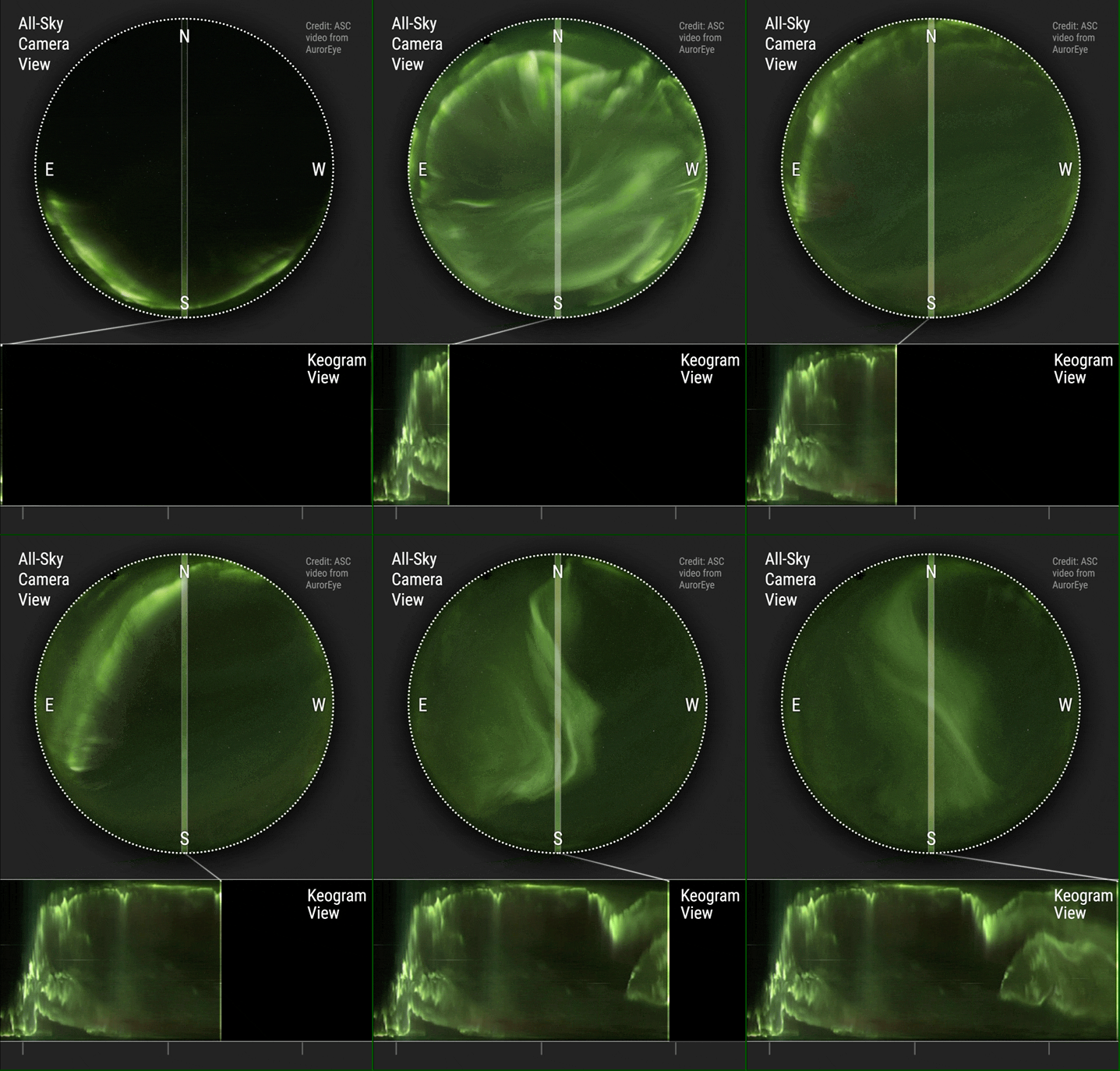
The aurora borealis or Northern Lights is an atmospheric phenomenon that occurs in the northern hemisphere of the planet.  It also occurs in the southern hemisphere where it is known as the aurora australis. Aurora are known to exist on comets, brown dwarfs, other planets and on some moons. Aurora are caused by solar wind interacting with magnetic fields and atmospheric particles.  Atmospheric particles become energized and form what is known as plasma.  Plasma is energized or ionized gas.  It is the fourth state of matter and has been so identified since about 1972.  Yes, your high school teachers who taught you the three states of matter were...well...not current in their physics.  You see plasma every day when you see the sun, an operating fluorescent light or an operating neon light. 

Read more: Aurora Borealis

The Wagon-wheel Effect (Nyquist Frequency and Aliasing)

Details
Category: Technical Notes
Published: 29 August 2021
Last Updated: 19 December 2024
Hits: 5062

The Wagon-wheel Effect, Stroboscopic Effects and Aliasing

Sometimes in movies one sees a stagecoach rambling through the countryside with some notorious highwayman (such as Dick Turpin) in hot pursuit.  The wheels appear to be going in the opposite direction at a very slow speed or not turning at all.  Images of any rotating object, including helicopter rotors or aircraft propellers, show this.  This phenomenon was mentioned one morning by YARS members during coffee and I decided to write an article about it.  One of our members mentioned a "stroboscopic effect" where, with a strobe light flashes at a sampling rate close to the period of motion causes this effect.  For example if a light flashes at 60 flashes per second (60 Hz) and the rotating object is rotating 60 revolutions per second (60 Hz), then the object will appear to be stationary.  If the object rotates at 61 revolutions per second, it will appear to slowly appear to move backwards.  At 50 revolutions per second it will appear to rotate slowly forwards. 

This effect can be used to measure the speed of moving objects simply by observing them.  It can also lead to irritation by persons sensitive to the effects, sometimes called "flicker".  This has nothing to do with a phenomenon called "rolling shutter" - which is merely a time delay artefact in a digital camera caused by how the camera scans an object over time, line by line (see https://www.youtube.com/watch?v=dNVtMmLlnoE ). 


Signal sampling representation.  The continuous or analog signal is sampled with discrete samples (as happens with an Analog to Digital Filter)

Read more: The Wagon-wheel Effect (Nyquist Frequency and Aliasing)

Subcategories

Technical Notes

  • Website Renewal Project

Online

We have 12856 guests and no members online

Newest Articles

  • QSOs with Stations in Israel, Palestine and Lebanon
  • QSOs with Stations in Iran
  • QSOs with Stations in Ukraine
  • FCC Approves AST Space Mobile's License for Operations in 430–440 MHz
  • G4FON SK - Morse Code Trainer

Archived Articles

  • January, 2026
  • September, 2025
  • May, 2025
  • April, 2025
  • March, 2025
  • February, 2025
  • November, 2024
  • October, 2024
  • August, 2024
  • July, 2024
  • © 2027 Yellowknife Amateur Radio Society