


Planning
- Details
- Hits: 1783
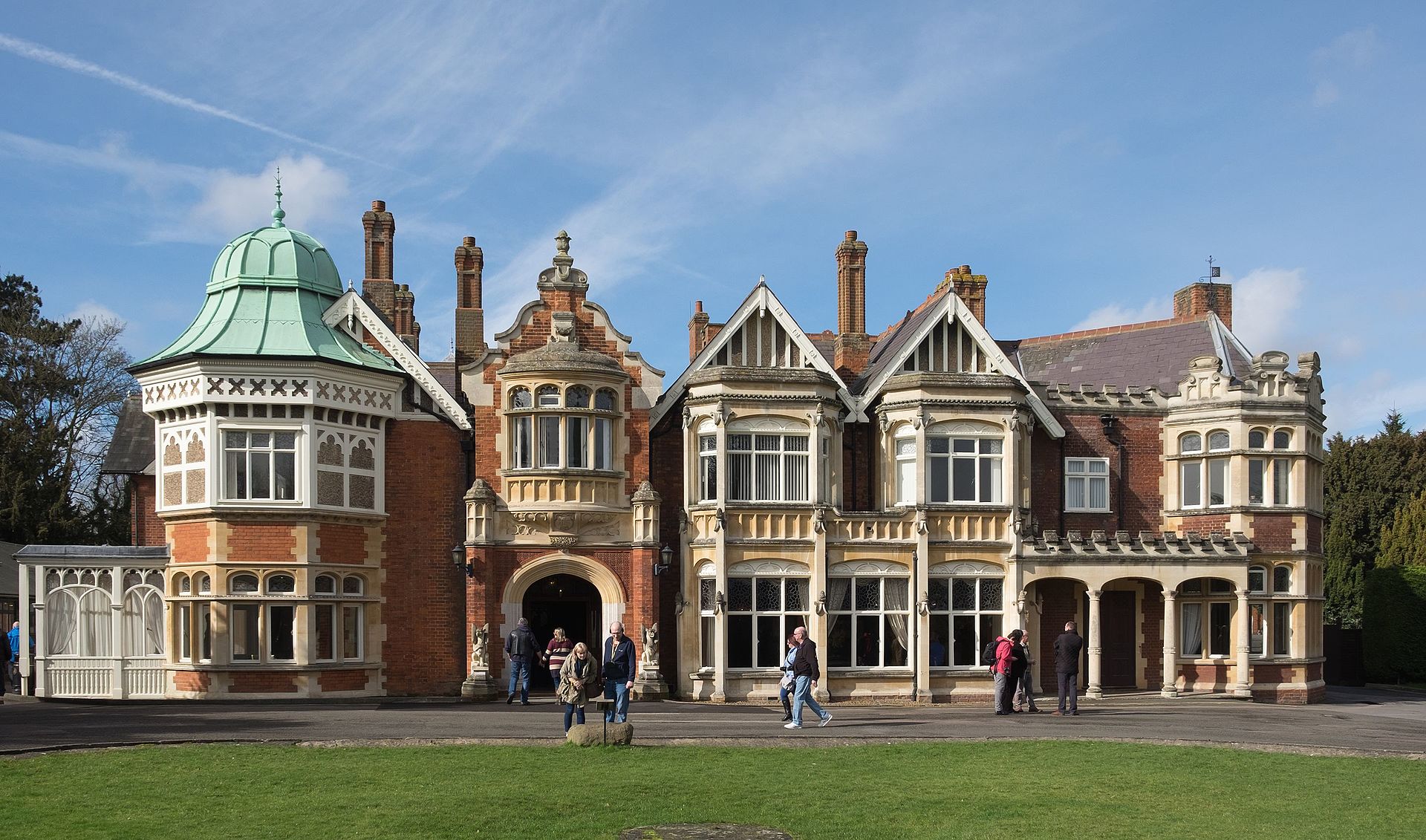
The AI working group has now been established. For an introduction into what is AI see the Wikipedia entry on this at: https://en.wikipedia.org/wiki/Artificial_intelligence . Simple AI is not the focus of this working group. That is more inline with the Linux working group or computing in general. Computing and telecommunications have long been associated with one another at least since the Second World War (Bletchley Park)
Learning About Artificial Intelligence
There is no getting around this, one will have to start learning Python. Python is a programming language that is very common at the present. It is derived from the programming language C. Specifically Python 3.x is to be used. We need to be careful about resources out there in that some are oriented towards Python 2.x and there are significant differences with Python 3.x. Generally anything released after 2008 should be a good source. Python 2.x has been discontinued since 2020 (Python 2.7.18 was the last release). At the moment I am running Python 3.11.0. I encourage you to read the Wikipedia entry (https://en.wikipedia.org/wiki/Python_(programming_language) ) and look at its sources. The Python official website is at https://www.python.org/ .
Python is open source (which means it is free). Options:
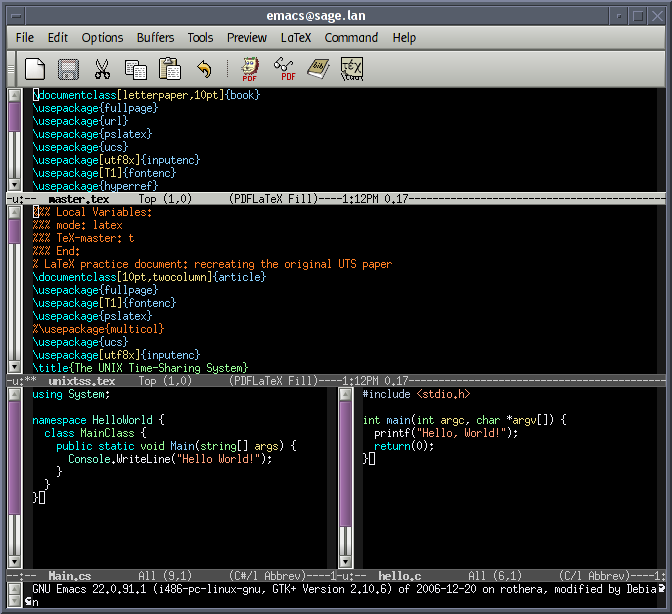
- Take an old Laptop and install a Linux operating system (see: Linux project). For installation assistance of the operating system, make use of the Internet and YouTube. Most Linux distributions come with Python installed. When installed, check the version. If necessary you may need to update it (especially if it is not version 3.x). You may also consider installing an Integrated Development Environment (IDE) such as shown in Figure 2. A simple editor could work, however that is probably for more experienced users and users who veer towards minimalism (some amateur radio applications go in that direction). One can also access python directly from the console or terminal in Linux. Our recommendation is to go with the Linux installation on an old obsolete laptop (perhaps one of those ones not capable of running Windows 10 or 11). This will give you a chance to experiment or "play" with the system at minimal expense, breathe new life into a laptop that is heading for "silicon heaven" - and show-off how nerdy you might be but at the same time saving the environment (by not generating e-waste gratuitously.
- Install a Python IDE into your current computer. This may offend your computer's security system. Details for Windows can be found at: https://www.python.org/downloads/windows/ . Details for the Mac OS can be found at: https://www.python.org/downloads/macos/ . There are some commercial vendors out there too. Although I have been using Windows for years, I find that as I explore Linux, I am learning a great deal about Windows systems. As a user, I have never really bothered to look into how Windows is set up or configured. I think that is probably quite common. For this reason we recommend against this approach unless you really know what you are doing in Windows or MAC - in case you "break" them. I tried to install Python IDE in Windows but I halted when security warnings came up.
- Work Online. I am a beginner in all of this and it is increasingly evident there is a great deal of information online regarding AI and how to learn about what is AI (i.e. what is under the hood/bonnet). Google Colab provides a resource that includes instruction sheets and an online working terminal for python. It is based on Jupyter notebooks. On YouTube there are many instructional videos on Python, AI and computer science. PyTorch is an important resource and many of the online lessons are derived from its documentation. PyTorch is particularly focused on Large Language Models (LLMs), whatever those might be... Google Colab has the processing power of a high-end computer and it can be augmented (for a subscription). The free version is apparently suitable for early learners. Another source of information is the GitHub repository. This is the approach I am taking as I work through one of the videos on YouTube (it is 24 hours long...) that is based on Colab, PyTorch and GitHub.
Conclusion
This page is a work in progress. How is generative AI important to the amateur radio service? (we are always speaking of generative AI rather than simple AI such as FT-8) I put that to ChatGPT 3.5 (i.e. AI). Then I put this to ChatGPT: "Generate an MP3 file that simulates auroral flutter of a CW amateur radio QSO". It took a while to respond. The record, including the link to the MP3 file is at:
- Details
- Hits: 2049
This page is devoted to not-for-profit tools that can be used by any not-for-profit (or anyone else). It is a listing of tools that are in the public domain and freely available.
Accounting Software
- GNUCASH - This is an opensource small business financial accounting software. It has double-entry accounting amongst other features.
Office Software
- LIBREOFFICE - This is an opensource office suite of programs including a word processor, spreadsheet program, a slide presentation program and a database program.
- SCRIBUS - This is a full featured desktop publishing program.
- LATEX - This is a high quality typesetting program specifically designed for technical and scientific documentation. It is not a word processor but rather a type-setting program. It handles mathematical equations really well and there is quite a bit of user support online. It saves the master file as a text file and then from that it can generate a ghostscript or PDF file all type-setted. (https://www.latex-project.org/ )
- Project Jupyter - This allows for notebooks to be made using a markdown feature. These can then be used to generate a LaTex document. In addition it includes a Python shell and can support other programming languages. It is the basis of online systems such as Amazon SageMaker Notebooks, Google Colaboratory (Colab) and Microsoft's Azure Notebook. This is probably the future of scientific publishing and it is well beyond Mathematica. Colab for instance also uses generative AI. YARS will probably start using this and LaTex in the near future.
- Internet Archive: - If old software is your thing, the Internet Archive has a collection of abandoned-ware. Consider WordPerfect on Linux and the whole retrofuturism/steampunk movement. Your old computers may be old and unable to use new software, but maybe that is not really a problem and you can use old software. For an NPO this is definitely an option and very economical.
Amateur Radio
- Internet Archive: Digital Library of Free & Borrowable Books, Movies, Music & Wayback Machine - This link takes one to various publications re: amateur radio.
- 101 Spy Gadgets For The Evil Genius : Free Download, Borrow, and Streaming : Internet Archive
- Download & Streaming : The Internet Archive Software Collection : Internet Archive
- FLDIGI - a suite of digital mode software which includes ability to send pre-formatted ICS and RAC Radiogram message traffic
- WJST-X - a suite of weak signal digital mode software including FST4, FST4W, FT4, FT8, JT4, JT9, JT65, Q65, MSK144, and WSPR and ECHO for moon-bounce. Some of these modes are used for meteor-scatter. Local amateurs have been experimenting with that. These modes use a fair bit of processing power as they use algorithms that make use of Forward Error Correction (so that 8088 XT, without the math-coprocessor that you have, just will not cut it). We thank Joe Taylor, K1JT for putting these into the public domain.
- Project Jove - A NASA program to encourage STEM. One can build a radio telescope to observe the interaction of the solar wind and the aurora of Jupiter and some of its moons (Jovian decametric radio signals).
- https://en.wikipedia.org/wiki/List_of_free_electronics_circuit_simulators
Operating Systems (especially for older computers)
- https://linuxmint.com/
- https://puppylinux-woof-ce.github.io/
- https://sourceforge.net/directory/ham-radio/
- https://archive.org/
- https://en.wikipedia.org/wiki/FreeDOS
The amateur radio service has a tradition of recycling old equipment for its purposes including ex-military equipment, obsolete computers and old electronics and other things that can be re-used. The tradition is in part due to economy but it also facilitates resourcefulness, inventiveness and adaptation. This ties into an underlying philosophy of the Society - that we are the masters of technology and that technology serves us - we do not serve technology. Think of what that last statement means...
- Details
- Hits: 2553
Article Coming Soon. The items here are sources that will be used to construct the article...


https://en.wikipedia.org/wiki/WSPR_(amateur_radio_software)
https://www.abc.net.au/news/2021-05-05/malaysia-airlines-mh370-series-of-turns-before-disappearing/100116446
- Details
- Hits: 2594
Amateur radio nets are a useful means for amateur radio operators to communicate with other amateur radio operators. Nets can be local, national or international. As with many amateur radio activities, they are a means of practising for an emergency but also a means of building camaraderie.
Radio Amateurs of Canada has a list of Canadian nets, including when they occur, at: https://www.rac.ca/nets/ . Many of these nets are national and on the HF bands. Some are even through IRLP.
YARS will be restarting the following net as of 4 April 2022:
- The Yellowknife Amateur Radio Society Information Net weekly every Monday at 1900 h on 146.940+ with tone 100 Hz (VE8YK repeater). For the net script see: Weekly Information Net Script.
- Details
- Hits: 4676
The Canadian Forces Affiliate Radio System (CFARS) was established in 1978. Amateur radio volunteer operators and their stations are used but the frequencies in uses are outside of the amateur radio allocations and amateur radio call signs are not used. CFARS is allocated its own official frequencies by Industry Canada and its own identifiers.

CFARS has existed in various forms since about 1946, mostly under the Royal Canadian Air Force (RCAF). It was integrated into the Civil Defence Communications Organization and made up about 500 licensed radio amateurs across Canada, providing communications assistance in search and rescue, assistance during civil emergencies and operating weekly nets regionally and nationally. One of its most well-known activities was to enhance moral by providing phone patching - linking the phone network via amateur radio - and thereby allowing personnel in remote or foreign areas to communicate with home. One has to keep in mind the state of radiocommunications and telephones from 1946 to the advent of satellites and more recently of email. I remember my brother calling home from the Hall Beach Dew Line station around 1981 or so, and hearing the echo and time delays.

In the United States a similar system is operated called the Military Auxiliary Radio System (MARS). That system is managed by the US Army and US Air Force but sponsored by the United States Department of Defense. It is comprised of a volunteer force of over 3,000 amateur radio operators. Its origins stem back to 1925 when it was essentially a reserve for the US Army Signal Corps. The function of MARS is similar to that of CFARS, including the provision of morale radiograms and phone patches to members of the armed forces serving in Korea, Vietnam, the Cold War and the first Gulf War.
CFARS, as we now know it, came into being in 1976. It would
- operate on specifically allocated frequencies outside the amateur radio spectrum;
- provide membership to include military installation stations, military amateur radio unit/club stations and a number of designated volunteer affiliated licensed amateur radio operators;
- operate using quasi-military voice and operating procedures;
- operate on several different radio nets, for example: a Northern net, a Maritime or Her Majesty's Canadian Ships net, a United Nations Canadian Contingents nets, a National net, and a Training net; and
- use international call signs while operating within its own framework.
| 6878 kHz | Alpha |
| 15386 kHz | Bravo |
| 14960 kHz | Charlie |
| 15463 kHz | Delta |
| 14446 kHz | Echo |
| 21971 kHz | Foxtrot |
| 20963 kHz | Golf |
| 28715 kHz | Hotel |
| 13454 kHz | Juliet |
| 16449 kHz | Kilo |
| 20277 kHz | Lima |
| 13954 kHz | Mike |
| 6922 kHz | Whiskey |
| 6662 kHz | Xray |
| 4152 kHz | Yankee |
| 4223 kHz | Zulu |
The Yellowknife Amateur Radio Society was at one time a member of CFARS but its membership in that group has expired. While the Society has the technical capability to participate in CFARS activities, its participation has been sporadic and after an assessment in April 2023, the Society does not have the manpower to participate effectively. We do however encourage members of the Society or amateur radio operators in the North to participate if they have the time and equipment. The CFARS websites below give information on how to apply for membership.
Sources:
- Details
- Hits: 4116
What is it?

Meteor scatter or meteor burst communications (MBC) is a propagation mode that makes use of the ionization trail left behind a meteor as it burns up in the atmosphere. Meteors burn up in the atmosphere all the time. They are known as meteorites when the survive entry and hit the ground. In space they are known as meteoroids. When they enter the atmosphere they typically travel in excess of 20 km/s (or 72,000 km/h). This causes them to undergo aerodynamic heating as they experience friction with the upper atmosphere. They glow and usually become transformed into plasma, in the E-layer. The ionized trail only last for a few seconds. A radio burst is typically sent out (30-50 MHz) and it is bounced off the ionized trail. As a result, one can achieve a propagation distance of up to 1,200 miles. The best effects are seen during meteor showers. Interest in this mode faded with the advent of satellite communications in the 1960s. Nevertheless there is still some residual interest in that it may be more secure and is harder to trace where the sending signal originated.

Single side band (SSB) is a common mode used during meteor showers. Morse code can be used. Typically transmission speeds are high (in the order of 800 words per minute) - which is beyond human copying capability - therefore the mode is well suited to computers. A popular mode is MFSK441 using the famous WSJT-X software. Amateur radio operators often use MFSK441. JT6M seems to be replacing MFSK441 and it is especially optimized for the 6m band. Newer versions WSJT-X do not include meteor scatter programs, but the older versions are always available. WSJT was made available by Nobel laureate Joe Taylor K1JT and the software is open source and coordinated through the Physics Department at Princeton University.
Some local amateurs are using this mode on an experimental basis.
Using Broadcast FM Radio
You can experiment with this yourself with TV and FM DX. With the advent of digital TV, analog TV signals are rarely used anymore on 50-80 MHz. But the FM broadcast band is still in use from 88-108 MHz and very suitable for meteor scatter. During meteor showers one can even receive the 175-220 MHz band. That poses some interesting possibilities for amateur radio operators on 70 cm and the 1.25m bands. Lower frequencies tend to last longer that the higher frequencies. The optimum time is early in the morning, when the velocity of the earth is greatest (i.e. your location is tangent to its orbit around the sun) but meteor scatter can occur at anytime. The best times are during annual meteor showers, including
The annual major meteor showers are detailed below:
- January 3 – 4: Quadrantids
- April 22 – 23: Lyrids
- May 5 – 6: Eta Aquariids
- June 9 – 10: Arietids & zeta-Perseids
- August 12 – 13: Perseids
- October 21 – 22: Orionids
- November 3 – 5: Taurids
- November 16 – 18: Leonids (Note: activity varies, outburst only at about 33 year interval)
- December 13 – 14: Geminids
- December 22 – 23: Ursids
One can simply listen into an FM radio and try to detect distant FM radio signals. Some FM stations have RDS capabilities and that is one way to identify them. Alternatively you could try to tune into a known distant station and see what you can hear - ideally a station identification - or alternatively compare what you hear to their playlist. There is a possibility you are also hearing reflections off an airplane.
Sources
- https://physics.princeton.edu//pulsar/K1JT/devel.html
- https://fmradiodx.wordpress.com/2013/09/12/meteor-scatter-a-fun-way-to-receive-fm-radio-signals/
- https://en.wikipedia.org/wiki/List_of_radio_stations_in_Alberta
- https://en.wikipedia.org/wiki/List_of_radio_stations_in_British_Columbia
- https://www.rasc.ca/sites/default/files/RadioAstronomy_NovaNotes.pdf
- https://www.softpedia.com/get/Multimedia/Audio/Other-AUDIO-Tools/Spectrum-Lab.shtml
- Details
- Hits: 3185
The Automatic Packet Reporting System (APRS) is an amateur radio system using digital communications in order to monitor and send telemetry within a certain area, real time. Telemetry (remote sensing) is used in many fields but for amateur radio operators it can be used for weather stations, mobile tracking (on land, air or at sea) and so forth. With the advent of GPS sensors time can be recorded accurately and the position of an object can be reported.
Typically APRS data is collected at a remote site by sensors then it is converted into a digital stream and transmitted on an APRS frequency (in North America this is typically 144.390 MHz (in the lower 2 m band). The data stream is received by a nearby station and relayed (that station is called a digipeater) for local consumption. Eventually the data stream is injected into an APRS station that is connected to the Internet (so that station is called an APRS Internet System or APRS-IS) via an Internet connected receiver (IGate). With the data sent to the Internet, it can be collected by all users and combined and plotted on a map.
In the first image above we see APRS/IGate activity locally around Yellowknife on the afternoon of September 1, 2021. The website is at www.aprs.fi and it automatically goes to the location that your IP address is at. One can select on this map a satellite photo overlay or other types of map that show the relief of the terrain. Some observations:
- At the far northeast of Yellowknife is WX VE8WD-2 - this is the weather station of VE8WD on Prelude Lake about 20-30 km from Yellowknife. Time, temperature, pressure, windspeed and rain are all reported as is the digipeater VE8TEA in Yellowknife through which it is relayed.
- At the most easterly station, CYZF we find a weather station based at Yellowknife airport. While the weather data is similar to that of VE8WD-2, this station does not appear to be connected to any local digipeater or IGate but rather is APRS via TCPIP, which is an internet suite protocol. We think it was set up by KK5WM at some point and that is why it is labelled as being associated with KK5WM.
- Moving east across Yellownknife, we find VE8WD-11 with an "X" like indicator. This is the IGate but it is not in operation at the moment as its Internet connection is disconnected. If we open the Info we find location, altitude, course, speed, device and path information. Other associated stations and proximate stations are also reported.
- Moving south east, we find VE8TEA. We find similar information but also the last path as reading - "VE8TEA>APDW13 via TCPIP*, qAC. T2USANW". This station is not just a digipeater but is also acting as the temporary IGate.
- Moving to the north east, we find VE8PAT. This station is at École St. Patrick School and is the Society's primary emergency operating location (our EOC). It appears to be operational but it is not connected to the Internet as there is no TCPIP information. This is a digipeater - hence its name YKDIGI. In the list of nearby stations it identifies some other stations not on the map - VA3VML-7, VE8WD-1, VE8WD, VE8WD-7, VE8CK-N and VE6BRZ. These stations report hearing YKDIGI on the air. Some of these stations are local operators and some are visitors from out of town.
- Finally moving north, we find VE8SKI. This is the weather station that we installed at the Yellowknife Ski Club in August 2021. The second and third images above show the inside of the station. It is similar in design to the Prelude Lake station VE8WD-2.
APRS data is used by amateurs in interesting applications including,
- to track train movements and positions by AMTRACK, the American national railway system;
- by boaters to allow their movements to be monitored;
- by amateur radio operators conducting high altitude balloon experiments (and allowing them to recover the payloads when the fall back);
- tracking animals;
- tracking and relaying signals via satellites, including the International Space Station;
- direction finding;
- etc.
The limit is only constrained by the limits of the imagination. One of our members is planning to construct an APRS compost monitor.
Sources:
- http://www.aprs.org/
- AX.25 protocol
- AIS System for Marine Traffic
- http://www.findu.com/
- https://www.pinpointaprs.com/
- https://github.com/wb2osz/direwolf
- https://www.irlp.net/pi/manual.pdf
- https://www.irlp.net/guidelines.html
- Details
- Hits: 2527
YARS was instrumental in the development of distracted driving laws as they relate to the use of mobile amateur radios. This is a topic of national concern especially in the face of the use of cellular telephones while driving. Amateur radio operators are seen generally as providing a useful public service.
In the Northwest Territories some years ago a converted bus-camper broke down outside of Behchokǫ̀. Fortunately VE8NSD just happened to be on the road and came across the vehicle broken down. The vehicle was beyond the range of any cell phone network (that is common on stretches of highway in the Northwest Territories). He was able to contact the YARS repeater in Behchokǫ̀ (VE8RAE), which is linked to the Yellowknife repeater (VE8YK). VE8IR just happened to be monitoring the VE8YK repeater. The message got through and VE8IR was able to telephone for a recovery vehicle to go out to the area and recover the converted school bus. No police resources were expended. Fortunately this occurred in the summer; had it been winter, the event could have been a life or death matter. This is an example of the public service role that amateur radio operators can perform. There are many more examples, but this one is particularly relevant to highway safety.
Another public service event occurred some years ago when a commercial vehicle was in a local garage for servicing. Its land mobile radio (LAD) was left on and the microphone fell in between some seats. The push to talk switch was activated. This created interference on the commercial radio frequency. YARS was called upon to apply its direction finding techniques and we were able to find the offending vehicle. The radio was located and switched off. The LAD frequency was clear once again for general use.

In the Northwest Territories the Restricted Electronic Devices Regulations, R-100-2011 governs the use of amateur radio equipment installed in a motor vehicle. Such licence plates are often referred to as "vanity" plates, but there is nothing vain about them. They are a class of public service licence plates, not unlike licence plates for veterans.
YARS had input into amendments concerning distracted driving in the parent Act and these regulations when they were made. The regime governing this matter in the Northwest Territories is one of the most accommodating in Canada. For a cross jurisdictional review see: https://www.rac.ca/distracted-driving/ .
- Details
- Hits: 2392
Advocacy v. Lobbying
Advocacy by definition is where a group, such as the Yellowknife Amateur Radio Society (YARS), aims to influence decisions with political, economic or social institutions. While YARS is not a lobbying organization per se, as it is composed entirely of volunteers. No member of YARS is paid to communicate with public office holders. YARS does have as its objects (as stated in its Articles of Incorporation)
- to foster, encourage and assist on projects, which in the opinion of the members will promote Amateur Radio;
- to further the enjoyment and understanding of amateur radio; and
- to provide assistance and support to Civil Authorities in times of emergency.
It is only natural that as part of these objectives it seek to influence decisions that directly concern these objects. In the Northwest Territories, YARS is often considered to be a stakeholder not for profit organization (NPO) or a non-governmental organization (NGO).
National and International Advocacy
YARS, through its affiliation with Radio Amateurs of Canada (RAC), participates in bringing issues to its attention or engaging in issues of interest to radio amateurs nationally and internationally. Nationally, RAC has had a say in the development of regulations and statutes including technical requirements for amateur radio apparatus. Internationally it has had a say in the development of the CEPT permits which authorize amateur radio operators qualified and licensed in Canada to operate in other countries. RAC sends representatives to the International Telecommunications Union - World Radiocommunication Conference every four years. These conferences have led to the international expansion (and subsequent national expansion) of amateur radio operations on new bands and frequencies, giving the amateur radio service a chance to experiment and utilize new equipment and modes of operation in the face of new challenges from previously unused parts of the radio spectrum.
Stakeholder Input in Legislation-making in the Northwest Territories
YARS was instrumental in the development of distracted driving laws as they relate to the use of mobile amateur radios. This is a topic of national concern especially in the face of the use of cellular telephones while driving. In the Northwest Territories the Restricted Electronic Devices Regulations, R-100-2011 governs the use of amateur radio equipment installed in a motor vehicle.

YARS was also instrumental in safeguarding the use of amateur radio service licence plates on motor vehicles in the Northwest Territories. Such licence plates are often referred to as vanity plates, but there is nothing vain about them. They are a class of public service licence plates, not unlike licence plates for veterans. This is also a national and international interest as a Google search will reveal (and these plates are highly collectable). The Northwest Territories is one of the first jurisdictions to issue such plates in Canada. In the Northwest Territories the governing legislation is the Motor Vehicle Registration and Licence Plate Regulations, R-100-2011.
YARS provided stakeholder input during the development of the Emergency Management Act, SNWT 2018,c.17 and in particular provisions about volunteers including provisions regarding compensation (section 23) and liability (section 24). It also provided input to the amendment of section 4 of the Workers Compensation Act, SNWT 2007,c.21 to ensure that that Act would also apply to volunteers.
Conclusion
YARS is very active in advocacy matters that relate to the achievement of its objects. These activities are not always visible as YARS does tend to keep a low profile, but they are consistent with its objects and demonstrate that YARS is active in the community on behalf o all radio amateurs in Yellowknife, the Northwest Territories and, to some degree, in Canada and internationally.
Sources:
Non Profit Law in Canada (Council on Foundations)
- Details
- Hits: 2771
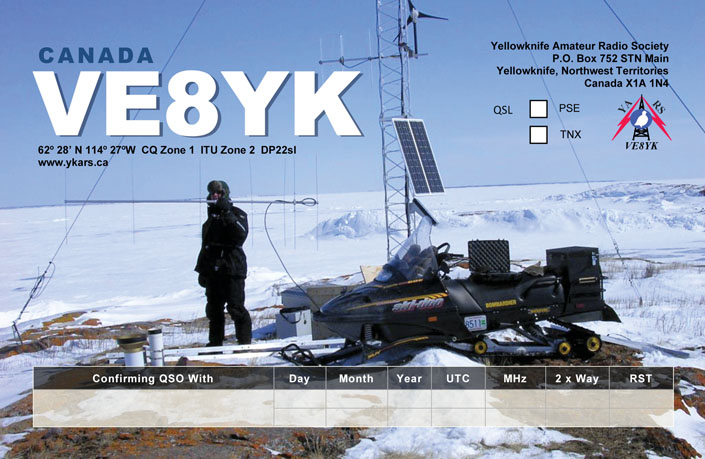
A QSL Card is a type of radio report acknowledgement in the amateur radio service. Normally it is an acknowledgement from a station that another station has received signals. It can be in the amateur radio service, CB radio, broadcast radio or TV or some other form of radio transmission - such as, for example, the hearing of a navigational beacon or a maritime weather fax transmission. Usually the card is in the form of a post card and sent through the mail.
QSL is derived from the Q-Code QSL?, which means "Do you confirm receipt of my transmission?". The Q-Code in reply is QSL with no question mark. On the card there are details about the transmission. Some people collect these cards and with a stamp on them, they have potential philatelic (i.e. stamp collection) value.
The card itself is rather cheap to produce (about $0.10 per unit) when ordered in quantity. It is the postage that is not cheap. To send a card from Canada to the USA, the cost is in the range of $1.07 (see postal rates). Usually when an amateur radio operator requests a QSL Card, they will enclose a few dollars to cover postage or a self-addressed and pre-stamped envelope (if they have Canadian stamps on hand). At one time they might include International Reply Coupons (IRCs). These coupons were introduced by the Universal Postal Union in 1906 but their use has been declining, so much so, that the Royal Mail (i.e. United Kingdom) and the United States Postal Service ceased selling IRCs in 2011 and 2013 respectively. Italy will be the next country to phase them out. Canada is still selling them. There is an interesting connection to IRCs and Charles Ponzi, after whom the Ponzi Scheme is named.

Generally YARS does send out QSL Cards when requested and we appreciate those that send a self-addressed stamped envelope, a few dollars to cover postage, Canadian postage or an IRC. The VE8 prefix in the club callsign is the second rarest in North America and much sought after by radio amateurs. For some this proof of contact is critical to various awards. For many amateurs the QSL Card holds great meaning. Unfortunately for YARS this means bulk processing.
There are ways to streamline QSL cards through the QSL Bureau offered by one's national amateur radio organization. For example consider the Radio Amateurs of Canada QSL Bureau . YARS does make some use of the RAC QSL Card Bureau but it makes much more use of direct mail through the postal system. We also make use of eQSL, an electronic QSL Card system.
Further reading: